Independent Preparation Guide Disclaimer: This is an independent preparation guide and is not affiliated with or endorsed by Harvard International Review or Harvard University. It does not represent an official Harvard College programme.
When the 2026 HIR Academic Writing Contest asks how social media, streaming, and algorithmic recommendation reshape cultural consumption, many China-based writers instinctively reach for American tech giants as their primary examples. The result is predictable: essays that read like second-hand commentary written from thousands of miles away. But Theme A—Global Culture in the Digital Era—offers a rare opportunity to build arguments from direct observation of digital culture phenomena that are unfolding with particular intensity in East Asian markets.
Why Proximity Matters for Theme A
The HIR prompt for Theme A frames a genuinely open question: “In the era of social media, streaming, and algorithmic recommendation reshaping how people consume culture, what opportunities and challenges does global culture face?” It asks whether digital technology promotes multicultural integration or intensifies cultural homogenization, and whether certain cultural forms have gained new vitality in the digital age.
These questions do not specify where to look for answers. Yet many students automatically adopt what might be called the “California default”—treating Silicon Valley platforms as the universal case study. This is a missed opportunity. According to the 2026 HIR theme summary, the contest directs attention toward “contemporary international society’s core challenges” under technological transformation, with themes that are “no longer limited to traditional international narratives” but instead focus on global vision amid technological change and digital waves.
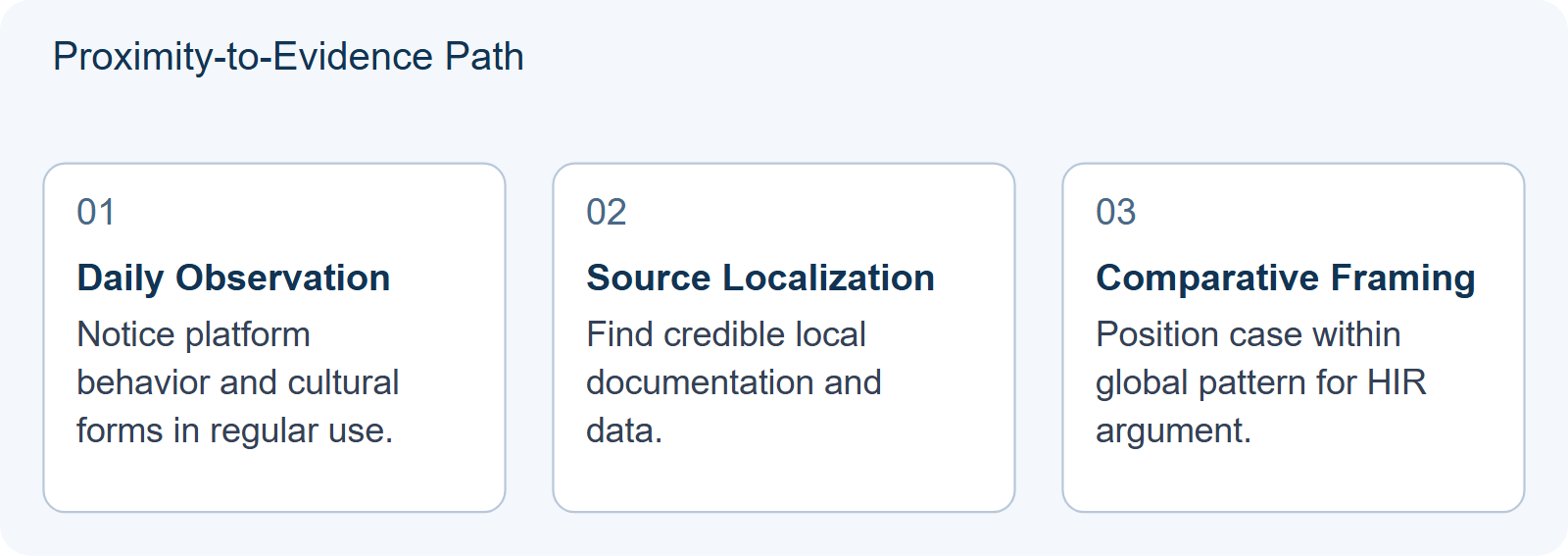
For writers in China, the alternative is to apply what might be termed the “proximity as evidence” principle: using digital culture phenomena you can observe directly, access in local languages, and document with primary sources. This does not mean abandoning global scope. Rather, it means grounding global claims in specific, well-documented cases that most international competitors cannot replicate.
Three Researchable Sub-Topics Beyond Silicon Valley
Based on the 2026 HIR Theme A prompt, three research directions lend themselves particularly well to China-based observation and source access.
Short-Video Platform Governance and Cultural Form
Short-video platforms represent one of the most significant transformations in global cultural consumption over the past decade. Unlike the longer-form content dominant on Western platforms, the short-video format has developed distinct aesthetic conventions, content moderation challenges, and creator economies in Chinese and East Asian markets.
A writer might examine how platform governance structures shape what cultural forms proliferate. For instance, the relationship between algorithmic recommendation and the preservation or erosion of regional performance traditions—such as certain forms of folk music or oral storytelling—offers a concrete angle on whether digital technology revitalizes or homogenizes culture. The key is to move beyond platform-generic claims and identify specific mechanisms: how recommendation algorithms weight content, how creator compensation structures incentivize certain formats, and how user behavior data from East Asian markets compares with available data from other regions.
Cross-Border Fandom Economies
Digital platforms have enabled fan communities to operate across national boundaries with unprecedented speed and coordination. China-based writers can observe directly how fan economies function across platforms, how intellectual property regimes interact with fan production, and how cultural content from one national market gets reinterpreted in another.
This direction connects directly to the Theme A question about whether digital technology promotes multicultural integration or homogenization. Fan practices often involve active translation, adaptation, and remixing—activities that suggest cultural blending rather than simple replication. Yet the same platforms that enable this also impose standardization pressures through interface design, content policies, and monetization structures. A thesis might argue that cross-border fandom represents a distinctive digital-era cultural form that neither fits the “integration” nor “homogenization” narrative straightforwardly, requiring more nuanced analytical frameworks.
Digital Heritage Preservation
The third direction examines how digital technology affects the preservation and transmission of cultural heritage. This includes digitization projects, virtual museum experiences, and the use of digital tools to document endangered practices. The 2026 HIR Theme A prompt explicitly asks whether certain cultural forms have gained new vitality in the digital age; digital heritage initiatives offer a direct way to engage this question.
China-based writers have access to extensive Chinese-language documentation of such projects, including government reports, academic assessments, and platform announcements. The analytical challenge is to evaluate these sources critically and situate them within an international affairs framework rather than treating them as purely technical or domestic developments.
Evaluating Chinese-Language Sources for HIR Credibility
A significant challenge for China-based writers is demonstrating that Chinese-language sources meet HIR’s expectation of research-based argumentation with proper citation. The contest requires that submissions “clearly reflect research-based perspectives and insights” and comply with citation standards.
Practical criteria for source evaluation include:
- Institutional affiliation: Does the source come from an academic institution, government agency with research capacity, or established media organization with editorial standards?
- Methodological transparency: Does the source explain how it gathered and analyzed information?
- Cross-verification: Can claims be corroborated across multiple independent sources?
- Recency and relevance: Does the source address current platform dynamics rather than outdated platform generations?
For platform-specific claims, company transparency reports, academic studies using platform data, and regulatory filings often provide more solid grounding than journalistic accounts alone. The goal is not to avoid Chinese-language sources but to select and present them in ways that meet international academic expectations.
The Comparative Digital Culture Framework
The most effective Theme A essays from China-based writers typically adopt what can be called a comparative digital culture framework: rather than importing American cases or treating East Asian cases as purely local phenomena, they compare how similar digital technologies function across different cultural and regulatory contexts.
This framework addresses a common pitfall: the essay that describes Chinese digital culture as exotic or exceptional, or conversely, the essay that treats American platform dynamics as universal without examining their specific institutional foundations. A comparative approach asks: given similar technological affordances, why do cultural outcomes differ? What role do regulatory frameworks, user demographics, content ecosystems, and business models play?
For example, a writer examining short-video culture might compare how similar recommendation algorithms produce different content ecosystems in different markets, then theorize what this implies about the relationship between technology and cultural form. The argument advances not by asserting that one market is representative, but by showing how cross-market comparison reveals patterns invisible from any single case.
Testing Your Argument for Novelty
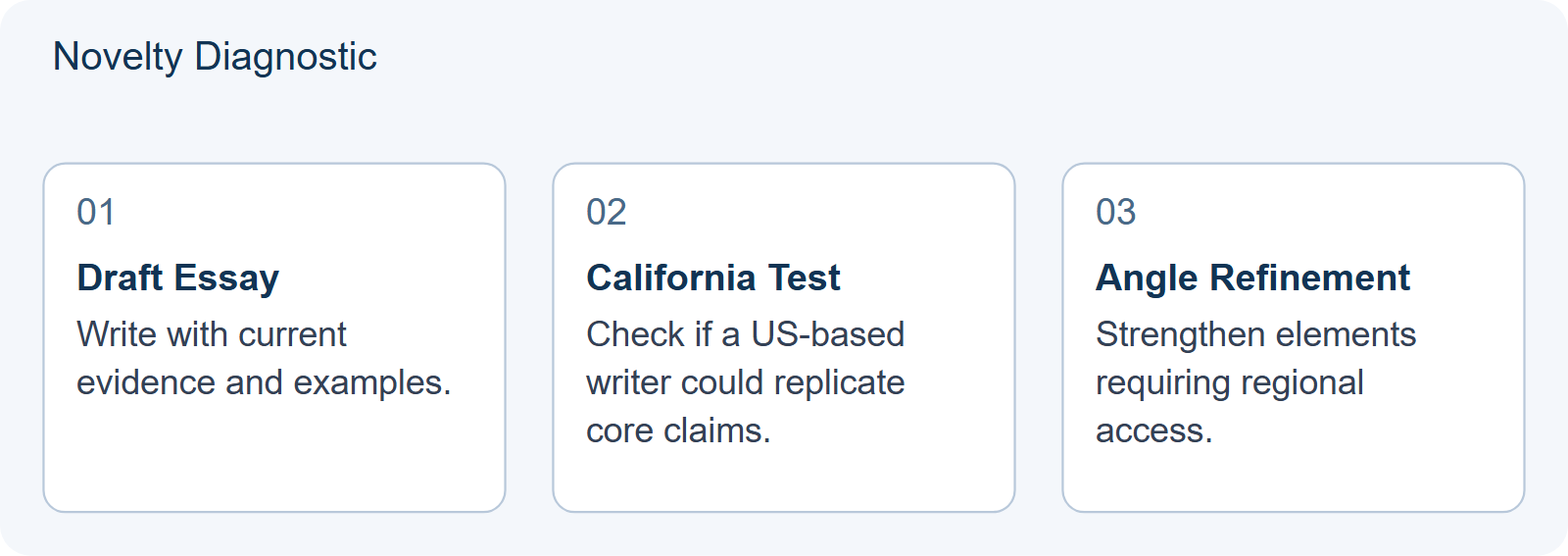
A useful diagnostic for Theme A essays is what might be called the “could this be written from California?” test. If the core evidence and examples in your essay could be assembled by a writer with no regional access and only English-language sources, your essay likely lacks distinctive contribution.
This does not mean avoiding all American examples. Global scope requires multiple reference points. But the essay should contain at least one substantial analytical move—whether empirical, theoretical, or methodological—that depends on the writer’s specific position and access. For China-based writers, this often means leveraging language skills, direct observation, or access to regional documentation that most international competitors cannot replicate.
The 2026 HIR theme summary’s emphasis on “global vision” rather than traditional international governance narratives creates space for this kind of contribution. Essays that demonstrate how digital culture phenomena in one region illuminate broader global dynamics tend to stand out precisely because they avoid the generic.
Integrating Non-English Sources in AP-Style Essays
Many China-based writers worry that extensive use of Chinese-language sources will alienate international reviewers. The solution is not to avoid such sources but to integrate them strategically within an essay structure that remains accessible to international readers.
Practical techniques include:
- Contextual translation: When introducing a source, briefly explain its significance and credibility rather than assuming reader familiarity.
- Balanced citation: Combine regional sources with internationally accessible scholarship to demonstrate engagement with broader academic conversations.
- Explicit framework: State clearly how regional cases illuminate general patterns, so readers understand why specific examples matter to the overall argument.
The HIR contest evaluates writing quality, organizational clarity, and persuasive technique alongside research substance. Non-English sources enhance rather than detract from an essay when their relevance is made explicit and their credibility established.
Preparing for Theme A Research and Coaching
Before requesting HIR coaching or research support, prospective students can prepare by clarifying their own access and interests. Useful preparation includes:
- Identifying which digital platforms or phenomena you observe regularly in daily life
- Noting any language skills or regional access that might differentiate your research position
- Skimming recent Chinese-language media or academic coverage of digital culture topics
- Formulating one or two preliminary questions that connect observed phenomena to the Theme A prompt
This preparation allows coaching conversations to focus quickly on research strategy and argument development rather than basic orientation. For writers considering the 2026 fall/winter submission cycle with a deadline of January 2, 2027, early engagement with regional source identification is particularly valuable given the research demands of strong Theme A essays.
Related resources on other 2026 HIR themes are available for Theme C: Technology, Innovation, and Power and regional evidence strategies. Guidance on non-English sources is also available.
Note: The Harvard International Review Academic Writing Contest is organized by the Harvard International Review, a student-run publication at Harvard University; it is not an official Harvard University program. The HIR contest is independent of this guide.
Frequently Asked Questions
Can I write Theme A entirely about Chinese digital culture, or do I need global examples?
A strong Theme A essay typically uses regional cases as entry points to global questions rather than treating any single nation as self-contained. The 2026 prompt asks about global culture, so your argument should ultimately address patterns beyond one national context. Chinese digital culture works well as a primary case when framed comparatively or as illuminating broader dynamics.
How do I cite Chinese-language sources in a way HIR reviewers will accept?
Cite Chinese sources using standard academic format with English translations of titles. Establish credibility by noting institutional affiliation and, where possible, corroborating with internationally accessible scholarship. The key is demonstrating source evaluation rather than expecting reviewer familiarity with specific publications.
Is it risky to choose a topic where most sources are in Chinese?
Risk depends on execution rather than source language alone. Essays that clearly explain why regional sources matter, translate key claims, and connect to international scholarly conversations tend to perform well. Essays that assume reader familiarity with regional context or fail to establish source credibility face greater challenges.