The 2026 HAWC Junior division — new this year for grades 7–8 — gives younger writers one theme: Inventions That Changed How We Live. The instinct is to tell the story of an invention. The stronger move is to argue one specific way it reshaped daily life or power, and then defend that claim. Here is a step-by-step approach built for Junior writers who want to sound analytical, not encyclopedic.
The Junior Prompt, Read Closely
Every word in a prompt is a clue. “Inventions That Changed How We Live” is not asking for the history of an invention — it is asking you to name a specific change in how people live and argue that a particular invention caused it. That single shift in reading separates a report from an essay.
The Junior division is for students in grades 7–8; grades 9–12 write in the Senior division with different themes. HAWC essays are short analytical pieces — roughly 800–1,200 words in AP Style — though you should confirm the exact Junior word band and rules on hir.harvard.edu, since HAWC is an independent contest run by the Harvard International Review and can adjust details year to year. If this is your first contest, read our plain-language overview of what the HIR Academic Writing Contest is before you draft.
One reassurance for grade 7–8 writers and their families: the Junior division is not a watered-down essay contest. It asks for the same kind of thinking as the Senior themes — a claim, evidence, and reasoning — scaled to a younger writer's experience. That is good news, because the habits you build here (arguing rather than summarizing, defending rather than asserting) are exactly the habits the Senior division and, later, university writing will reward. Treat this first entry as the start of a skill, not a one-off assignment.
Pick an Invention You Can Argue, Not Just Admire
Younger writers often choose the most famous invention they can think of and then get buried in its history. Choose differently. A good Junior subject passes three tests:
- One concrete change. Can you name a single, specific way life became different? (“People could keep food safe at home” beats “it changed everything.”)
- Explainable evidence. Can you find two or three facts you actually understand and could explain to a teacher?
- Narrow enough for ~1,000 words. If the topic needs a whole book, it is too big. Shrink it to one change.
The table below shows how to turn a big invention into one arguable change. These are scoping examples to steer your thinking — not essays to copy.
| Invention | Too broad (a report) | Arguable change (an essay) |
|---|---|---|
| The shipping container | “How global trade grew” | How it made distant factories cheaper than local ones, reshaping where things are made |
| Refrigeration | “The history of cold storage” | How keeping food at home changed shopping habits and household routines |
| The mechanical clock | “How people told time” | How shared, precise time made coordinated work and schedules possible |
| Vaccination | “A timeline of disease” | How preventing illness (not just treating it) changed how communities plan and grow |
Notice the right-hand column always names a change and hints at a cause. That is your argument in seed form.
Resist the pull of the “most important invention ever” essay. Judges have read a hundred grand tributes to the wheel or the internet, and those essays almost always drown in scope. A smaller, sharper subject — the barcode, the elevator, the sewing machine, canned food — often produces a better argument precisely because you can hold the whole thing inside one essay. In a Junior essay, ambition is measured by how completely you explain one change, not by how world-shaking your invention sounds.
Treat the Invention as a Lever, Not a Biography
This is the single most useful idea for the Junior prompt. A biography lists what happened: who invented it, when, and what came next. A lever essay shows a mechanism: the invention caused a change, and that change had consequences for how we live. Your job is to explain the middle arrow — the “because.”
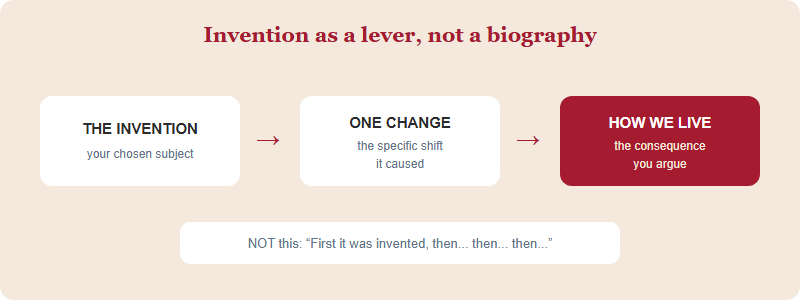
HAWC calls its standard “argument, not agenda,” and it applies to Junior writers too: persuade through careful analysis, not slogans or strong feelings. The contest's judging emphasizes exactly this kind of reasoning — you can see how it is weighted in our breakdown of the 60-point rubric, which rewards analysis of evidence over description.
Here is the lever move in miniature. Weak: “Refrigeration was invented, then it spread to homes, then supermarkets grew.” That is a timeline. Strong: “Because refrigeration let families store fresh food at home, weekly shopping replaced daily marketing — changing how households spend both money and time.” Same invention, but the strong version names a mechanism (“because… let…”) and a consequence (“changing how…”). Every body paragraph should be able to answer one question: so what changed, and why?
A Simple Structure That Holds
You do not need a fancy essay shape. A clean five-part skeleton keeps a ~1,000-word Junior essay focused and easy to defend.
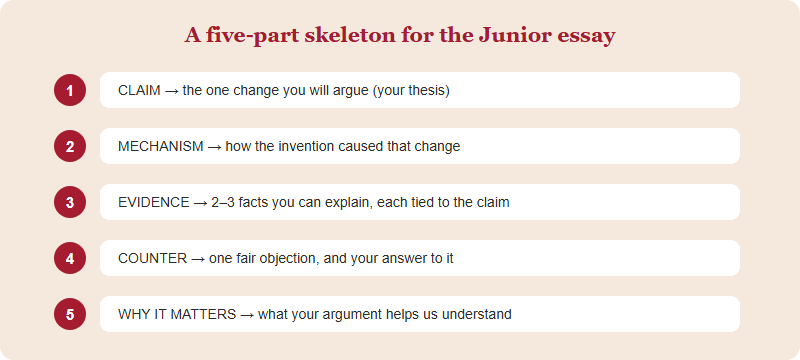
Aim for a single, clear thesis in the first paragraph so a reader knows your argument within the first 80 words. Then give each body section one job. A counter-consideration is not weakness — showing you tested your own idea is exactly what strong analytical writing does.
A few length tips for a ~1,000-word essay: spend roughly one short paragraph on the claim, two on mechanism and evidence together, a short one on the counter-consideration, and a tight closer on why it matters. Keep sentences you can read aloud in one breath — younger writers often bury a good point inside a 40-word sentence. And define any specialized word the first time you use it; a judge should never have to guess what you mean. Clarity, not complexity, is what makes a Junior essay feel mature.
Defending It Out Loud — and Keeping It Yours
HAWC includes a live oral round — a roughly 15-minute Defense Day where writers explain and defend their essays to a panel. Whether and exactly how the Defense Day round applies to the new Junior division should be confirmed on hir.harvard.edu; either way, practicing out loud is the best test of a real argument. If you can walk a parent or teacher through your claim, mechanism, and two pieces of evidence in three minutes, your essay is solid. Our Defense Day preparation guide shows how panels probe a writer's reasoning.
Try this at home: set a timer for three minutes and explain your essay to a family member who has not read it — your claim, how the invention caused the change, and your two best pieces of evidence. If you run out of things to say before the timer, your argument may be too thin; if you cannot finish, it may be too broad. This simple rehearsal surfaces problems while you still have time to fix them, and it builds the calm, own-your-argument confidence that a live panel rewards.
Two rules protect younger writers. First, the work must be entirely your own: AI-generated writing is not permitted, individual authorship is required, and an authorship declaration is part of the process — write in your own voice, which is also what earns credit. Second, do not over-claim. If you are unsure of a date or a number, verify it or leave it out; a Junior essay that argues one honest change well is far stronger than one padded with facts you cannot stand behind. Results vary, and no single essay guarantees an award — but a focused, genuinely-yours “Inventions” essay is a real piece of thinking you can build on.
Finally, a note for parents: your role is to ask questions, not to write sentences. The most useful thing you can do is play the friendly skeptic — “why did that change things?”, “how do you know?” — and let your child find the words. That keeps the essay honestly theirs, which the rules require and the oral round rewards, while still giving them the thinking partner every young writer benefits from.
FAQ
Who can enter the HAWC Junior division?
The Junior division is for students in grades 7–8; grades 9–12 enter the Senior division. Confirm current grade bands on hir.harvard.edu.
What is the Junior 2026 theme?
Per operator guidance the Junior theme is “Inventions That Changed How We Live.” Confirm the exact wording and rules on hir.harvard.edu.
Should the essay tell the invention's history?
No — argue one specific change it caused and how, rather than narrating a timeline. That shift turns a report into an essay.
How long should a Junior essay be?
HAWC essays are short analytical pieces of roughly 800–1,200 words in AP Style; confirm the Junior word band on hir.harvard.edu.
This is an independent guide operated by Hanlin Education for China-based international-school students. It is not affiliated with, endorsed by, or sponsored by the Harvard International Review or Harvard University. Competition themes, formats, deadlines, and rules can change — always confirm current details on hir.harvard.edu. We correct errors within 7 working days.