Two of the six Content dimensions on the HIR rubric — structure and transitions, and overall coherence — are scored separately and are worth five points each. Together that is ten of 60, a sixth of your total, sitting in the connective tissue between paragraphs. Almost nobody revises for it. This is how to make five good paragraphs read as one argument rather than five paragraphs.
The reason this matters more here than in a school essay is length. At 800–1,200 words you have perhaps five or six body paragraphs, so every join is load-bearing; one weak seam is 20% of your joins. And because it is a revision-stage problem rather than a research problem, it is fixable in a single evening — useful if you are working toward the Summer window, which closes in late August. Confirm the exact date and time on hir.harvard.edu before you plan your final week.
Structure and coherence are not the same thing
Students collapse these two into one idea, which is why they revise neither. The rubric keeps them apart deliberately, and the distinction is worth holding onto. Our line-by-line reading of the 60-point rubric covers the full grid; the short version:
- Structure and transitions is local. Is the order of paragraphs defensible, and does each paragraph connect to the one before it? This is about the joins.
- Overall coherence is global. Does the whole piece build one argument from first sentence to last, without drifting into a second, adjacent essay? This is about the thread.
An essay can score well on one and badly on the other, and the two failures look completely different on the page. Well-structured but incoherent: every paragraph flows neatly into the next, but by paragraph five you are arguing something that has quietly become a different claim — each step reasonable, the destination somewhere else. Coherent but badly structured: the argument is consistent, but the paragraphs could be shuffled without loss, because nothing depends on what came before. That second one is the more common failure in student writing, and it has a distinctive symptom: the essay reads as a list of true things about a topic.
The given–new rule
Here is the single most useful sentence-level habit for both lines, borrowed from how professional editors think about flow: start a sentence or paragraph with something the reader already has, and put the new material at the end. Old information first, new information last. Do that consistently and transitions largely stop needing signposting words at all.
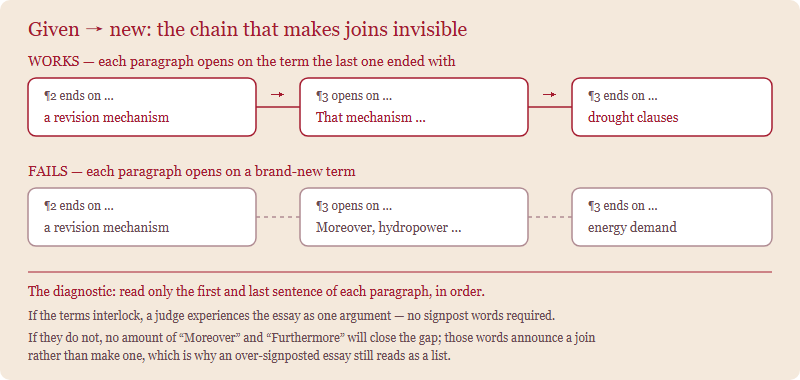
This is also why the standard ESL advice to “use more linking words” backfires here. A signpost word asserts a relationship; the given–new chain creates one. If the chain is there, “Moreover” is redundant. If the chain is missing, “Moreover” is a lie the reader notices.
Transitions that do analytical work — and the ones that do not
Not all transitions are equal. Some carry reasoning; others merely announce that the writer has moved on. The rubric rewards the first kind, because a transition that states a logical relationship is doing analysis in miniature.
| Transition type | What it tells the judge | Illustrative opener | Value |
|---|---|---|---|
| Consequence | Paragraph B follows logically from A | “Because the shares were fixed in a wetter decade, the treaty's drought clause…” | High — carries the argument forward |
| Concession | You have seen the objection and are answering it | “The obvious reply is that upstream storage is legal. It is — and that is the problem.” | High — also the strongest Defense Day preparation |
| Scope shift | You are moving deliberately, not drifting | “The same failure appears at basin scale, where the stakes are larger.” | High — protects coherence |
| Contrast with a reason | Two things differ, and you say why | “The 2015 agreement avoided this by pricing the flow rather than dividing it.” | Medium–high |
| Bare enumeration | Only that another item follows | “Secondly, there is the question of hydropower.” | Low — reads as a list |
| Bare addition | Nothing at all | “Moreover, energy demand is rising.” | Low — delete and rebuild the join |
| Topic announcement | That you are organising, not arguing | “This section will discuss the political dimension.” | Low — costs words, earns none |
A practical rule for the three low-value rows: delete the transition word first, then see whether the paragraphs still connect. If they do, you never needed it. If they do not, you have found a real structural gap that the word was papering over — which is exactly the gap the coherence line is scoring.
Three tests, fifteen minutes
Do these in order on a printed draft. Each takes about five minutes and each catches a different failure.
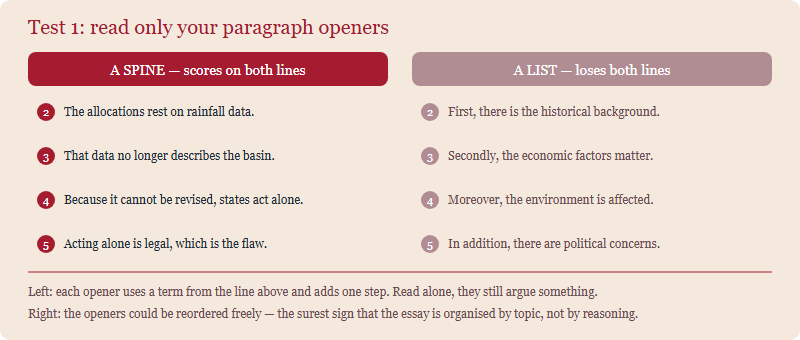
- Test 1 — the first-sentence read. Read only the first sentence of every paragraph, in order, ignoring everything else. Those five or six sentences should form a compressed version of your argument that someone could follow. If instead they form a list of subtopics, your paragraphs are organised by theme rather than by reasoning — the classic list essay.
- Test 2 — the key-term trace. Choose the two or three terms your claim depends on and highlight every appearance. Two patterns are bad. A term that appears in paragraphs one and five but nowhere between means the middle drifted. A term that changes wording each time — “revision mechanism,” then “adjustment process,” then “flexibility” — means the reader is tracking three ideas where you meant one. Vary sentences, never key terms.
- Test 3 — the shuffle. Number your body paragraphs, then ask whether any two could swap places without breaking anything. If they can, the order is arbitrary, and arbitrary order is what “structure” is scoring against. A genuinely structured essay has at least one paragraph that cannot move, because a later one depends on it.
The ESL trap: signposting as a substitute for logic
Students taught English academic writing in a second language are often drilled on connectives: firstly, secondly, moreover, furthermore, in conclusion. Those words are not wrong, and in an exam under time pressure they help a marker follow you. In a 1,200-word article judged partly on style, they create two specific problems.
First, they cost words you cannot spare. “Moreover, it is also important to note that” is eight words that carry no content; across an essay that is easily 60–80 words, which is a full paragraph of analysis you could have kept. Second, and more seriously, they let you skip the thinking. Writing “Furthermore” is easier than working out whether paragraph four is a consequence, a qualification or a counterexample — and the judge, reading for coherence, is asking precisely that question.
The replacement is not to delete every connective. It is to convert each one into a statement of relationship:
- “Moreover, X” → “X follows directly, because…”
- “However, Y” → “Y complicates this in one specific way:…”
- “Secondly, Z” → “The same pattern appears in Z, where…”
- “In conclusion” → delete it, and let the final paragraph return to the claim by name
Each replacement is longer by a word or two and does far more work. The counterargument transition deserves special attention because it pays twice: it is the strongest single move for the coherence line, and it is the material you will need in a 15-minute oral defense if you are selected. An essay that has already stated the best objection and answered it has done the hardest part of Defense Day preparation months in advance.
Where the joins fit in your final week
Sequence matters. Do the coherence work before the AP Style pass, because fixing a join changes sentences and you do not want to proofread text you are about to rewrite. A workable order for the last stretch: fix structure and transitions, then leave the draft alone for a day, then run the mechanical checks — word count inside 800–1,200, AP Style throughout, the authorship declaration, and the prohibition on AI-generated text, all confirmed against the official requirements rather than from memory.
Budget realistically. The three tests take fifteen minutes; acting on what they reveal takes two to three hours, because a broken join usually means rewriting a paragraph's opening and closing sentences. That is still the best-value revision available at this stage: you are not producing new research or new evidence, only making visible the reasoning you already did. If the contest structure itself is still new to you, our foundation guide sets out divisions, cycles and judging in one place before you start rearranging paragraphs.
Questions students actually ask
How many transition words should an 800–1,200 word essay have?
Fewer than you think. Aim for joins built on repeated key terms, and keep a connective only where it names a real relationship such as consequence or concession.
What is the fastest way to test coherence?
Read only the first sentence of each paragraph in order. If those sentences argue something on their own, you are coherent; if they list subtopics, you are not.
Is it bad to repeat the same key term?
No — vary your sentences, never your key terms. Renaming a concept mid-essay makes a reader track two ideas where you meant one.
Should I fix transitions before or after proofreading?
Before. Repairing a join rewrites sentences, so proofreading first means checking text you are about to change.
This is an independent guide operated by Hanlin Education for China-based international-school students. We are not affiliated with, endorsed by, or sponsored by the Harvard International Review or Harvard University. All example sentences are constructed for illustration and are not drawn from submitted entries. Rubric wording, word limits, cycle dates and submission requirements are set by the organiser and can change — confirm current details on hir.harvard.edu before you rely on anything here. Errors reported to our editorial desk are corrected within 7 working days.