Theme B of the 2026 HAWC Senior division asks you to make an argument about Security in a Multipolar World — one of three themes grades 9–12 can choose. It is the most tempting theme to over-write and the easiest to turn into a news summary. The fix is a narrow, defensible claim built on a defined case. Here is how to scope one that a judge, and a live panel, will respect.
What Theme B Is Really Asking
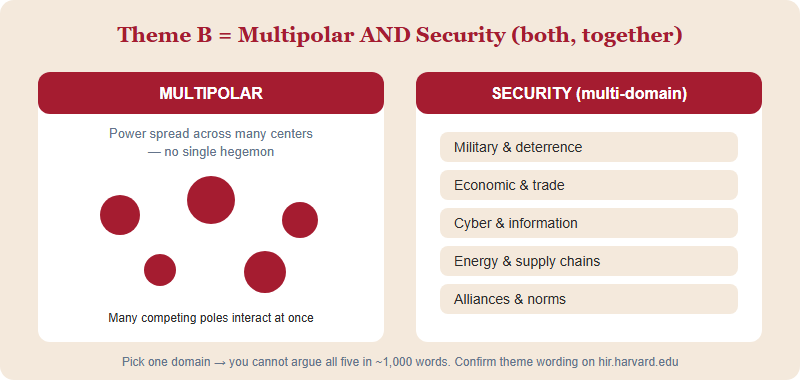
The phrase does a lot of work, and misreading either half is where most essays go wrong. Multipolar means power is distributed across many centers rather than concentrated in a single hegemon or a two-bloc standoff. Security is not only tanks and treaties; in current scholarship it spans military, economic, cyber, energy, and alliance or norm-based dimensions. Theme B rewards a specific claim about how security behaves when power is spread out — not a guided tour of world affairs.
In practice, a strong Theme B essay answers a question like: when many powers compete, does a particular kind of security get harder or easier to maintain, and why? That is an argument. “The world is dangerous and complicated” is not. If you are new to the contest, start with our overview of what the HIR Academic Writing Contest is, then come back to scope your claim. Confirm the exact 2026 theme wording and cycle rules on hir.harvard.edu — HAWC is an independent contest run by the Harvard International Review, and prompts can be refined year to year.
Here is the most common way Theme B essays fail before they begin: the writer reads “security” as only armies and weapons. That misreading forces you into the most saturated corner of the theme, where you compete with every other essay about great-power conflict. Reading security broadly — to include the economic, cyber, energy, and institutional dimensions above — opens quieter, more winnable ground where a sharp claim can actually stand out from the pile.
Three Angles That Work — and the One Trap
You do not need an original theory of world order. You need one lens narrow enough to defend. Three reliably strong approaches:
- A single flashpoint as a lens. Use one region, strait, border, or dispute to test a general claim about multipolar security. The region is your evidence; the argument is what it reveals.
- A non-military security domain. Cyber intrusions, energy dependence, semiconductor supply, or critical-mineral competition are underwritten by newcomers and let you avoid the crowded “great-power war” lane.
- An institution under stress. Take one alliance, deterrence relationship, or international norm and argue how multipolarity strains or reshapes it.
The trap is the news-recap essay: paragraph after paragraph narrating current events with no claim holding them together. HIR judges are reading for analysis, not headlines — the standard the contest calls “argument, not agenda.” If your essay would still make sense as a news article with your thesis deleted, you have written a recap. Our breakdown of the 60-point rubric shows how heavily “analysis of evidence” is weighted against mere description.
A quick test for whether you have an argument or a recap: cover your thesis with your hand and read the body. If every paragraph still makes sense as neutral reporting, your thesis is decorative, not load-bearing. In a genuine argument, removing the claim should make the evidence feel unexplained — the paragraphs exist because of the claim, not merely beside it. Build that dependency on purpose, and the essay stops sounding like a briefing and starts sounding like a case.
Building the Evidence Base
Theme B tempts writers to stack headlines. Resist it. Strong entries combine three ingredients — a concept, a case, and a check — and use only what they can explain.
| Evidence type | What it gives your essay | How much to use |
|---|---|---|
| International-relations concepts (deterrence, balancing, interdependence) | A vocabulary to explain why events unfold as they do | 1–2 concepts, defined in your own words |
| Historical or contemporary case(s) | Concrete ground your claim stands on | 1–2 cases you can walk through in detail |
| Verifiable data or documents | Precision and credibility; a check on assertion | A few exact, sourced figures — not a data dump |
| Counter-consideration | Shows you tested your own argument | One honest objection you answer |
Depth beats breadth every time. An essay that explains two cases well will out-argue one that name-drops ten. This matters doubly because HAWC includes a live oral round — you should not cite anything you could not explain out loud. See our Defense Day preparation guide for how the panel probes your evidence. Cite exact figures, dates, and sources, and confirm any specific claim rather than paraphrasing from memory.
Balance matters as much as depth. An essay that is all concept reads as abstract and unfalsifiable; one that is all case reads as description; one that is all data reads as a spreadsheet with sentences. The strongest Theme B entries braid the three — a concept to explain, a case to ground it, and a figure or two to verify it — so each element does a job the others cannot. When in doubt, cut a second example and spend the space explaining your first one more carefully.
From Theme to Thesis: A Narrowing Method
The gap between a theme and a thesis is where most Theme B essays are won or lost. Do not start writing at the theme level. Narrow in disciplined steps until you reach a single sentence you could say aloud and defend.
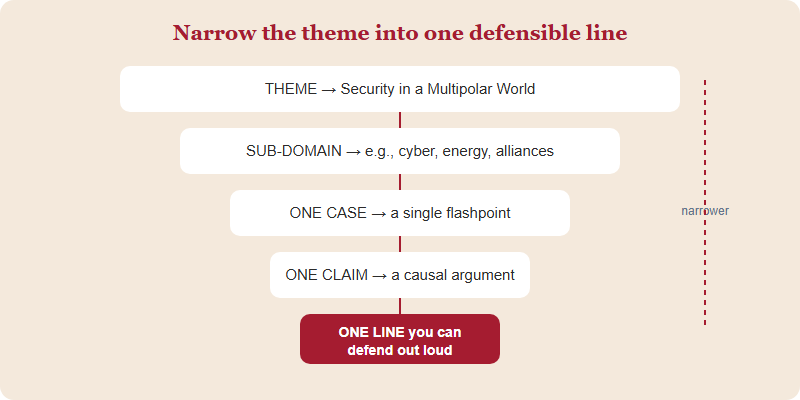
A worked example of the funnel in action: Theme (Security in a Multipolar World) → sub-domain (energy security) → one case (a single country's pipeline dependence) → one claim (that dependence hands a supplier disproportionate leverage even without military force) → one line you can say in ten seconds and back with two pieces of evidence. Notice the essay never tries to explain the whole world — it explains one mechanism completely.
One more discipline: name your counter-consideration before a judge does. A single honest objection — “a skeptic would say the leverage I describe is offset by X” — followed by your measured answer signals that you stress-tested the claim yourself. On a theme as contested as global security, the writer who anticipates the pushback almost always reads as more credible than the one who pretends none exists. Save roughly one short paragraph for it near the end, just before you land your closing line.
First-Party Coaching Notes for China-Based Writers
Working with international-school writers across China, our editors see the same split on Theme B (patterns are de-identified, and results vary from student to student). The strongest drafts commit early to one case and defend a causal claim about it. The weakest try to survey every region and end up asserting rather than arguing. If you are choosing between Theme B and the other two, the deciding question is not “which sounds most impressive” but “which case can I actually explain in detail.”
A third pattern is quieter but decisive: the strongest Theme B writers choose a case they are genuinely curious about, not the one they think sounds most sophisticated. Curiosity shows up as specificity — the writer simply knows the details — and specificity is what makes an argument feel earned rather than assembled. Pick the case you would happily read three long articles about; it will carry your essay much further than a fashionable one you secretly find dull.
Two practical notes. First, the 2026 Summer cycle is open now; operator guidance for the China region lists a late-July registration window and a late-August submission window, with the submission deadline noted around August 24 (ET) — but confirm current dates on hir.harvard.edu, as some public listings show an August 31 window, and the site runs on official time zones. Second, write in your own analytical voice: AI-generated writing is not permitted, individual authorship is required, and the oral round rewards a student who genuinely owns the argument. None of this guarantees an award — but a tightly scoped Theme B essay is the version worth defending.
FAQ
What does “multipolar” mean in Theme B?
It describes a world where power is spread across many competing centers rather than one dominant state. Confirm the 2026 theme wording on hir.harvard.edu.
Can Theme B be about non-military security?
Yes — cyber, economic, energy, and alliance security are all fair game and often less crowded. Anchor it to one case you can explain.
How many examples should a Theme B essay use?
Usually one or two cases explained in depth beat many shallow ones, especially since HAWC includes a live oral defense round.
How long is the essay?
HAWC essays are short analytical pieces of roughly 800–1,200 words in AP Style; confirm the exact 2026 word band on hir.harvard.edu.
This is an independent guide operated by Hanlin Education for China-based international-school students. It is not affiliated with, endorsed by, or sponsored by the Harvard International Review or Harvard University. Competition themes, formats, deadlines, and rules can change — always confirm current details on hir.harvard.edu. We correct errors within 7 working days.