If you are entering the HIR Academic Writing Contest Summer cycle, you have roughly four weeks left. The official contest page lists the Summer submission date as Aug. 24, 2026, with Defense Day on Oct. 5. Confirm that date on hir.harvard.edu before anything else, then diagnose which of four states your draft is actually in and spend the remaining weeks accordingly.
Settle the date before you settle the draft
This is not a formality, and it is the reason this article opens with a calendar rather than with writing advice. Secondary guides, school handouts and older planning pages do not always agree on the Summer cycle date, and a difference of one week is the difference between submitting and not entering at all.
What the official contest page currently lists:
| Cycle | Submission date listed | Defense Day listed | What it means for you now |
|---|---|---|---|
| Spring 2026 | May 31, 2026 | July 11, 2026 | Closed. Reference point only |
| Summer 2026 | Aug. 24, 2026 | Oct. 5, 2026 | The live window. Plan every gate backwards from here |
| Fall/Winter | Jan. 2, 2027 | Feb. 5, 2027 | Your fallback if four weeks is genuinely not enough |
Three practical notes follow from that table.
- Plan to the earlier date, always. If you have seen a later August date anywhere, including in an older article on this site, treat Aug. 24 as your working deadline until the official page tells you otherwise. Planning to an earlier date costs you nothing if you are wrong. Planning to a later one costs you the entry.
- Watch the time zone. Beijing time runs 12 hours ahead of U.S. Eastern Daylight Time. An Eastern-time cut-off therefore falls in the middle of the following day in China, which sounds like a bonus and behaves like a trap when your school Wi-Fi fails at lunchtime. Confirm whether a specific cut-off hour applies, and submit a full day early regardless.
- Do not assume a separate regional deadline. The contest page publishes one set of cycle dates rather than region-specific ones. If a school, agency or programme gives you a different internal date, that is their internal date for collecting your work, not the contest deadline. Both may bind you; only one is published by the organiser.
Diagnose the draft you actually have
Most four-week plans fail because they are written for an imaginary student who is exactly on schedule. In practice, at four weeks out, entries fall into four recognisable states, and each one needs a completely different allocation of the remaining time. Run the diagnostic before you open your document.
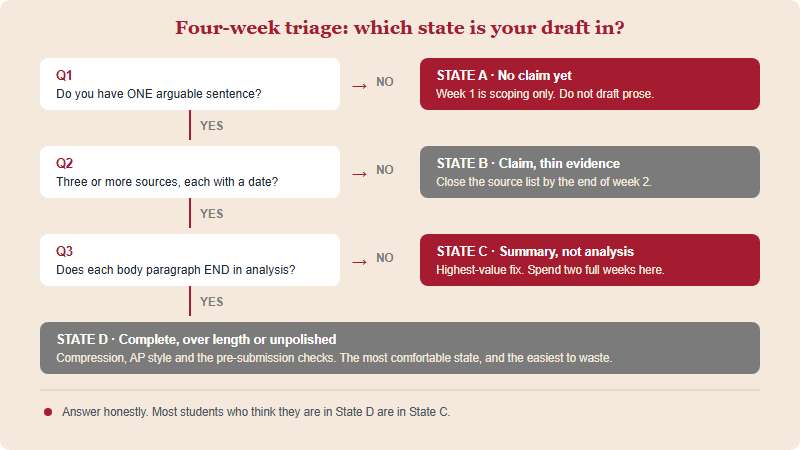
The single most common misdiagnosis is students in State C who believe they are in State D. The draft is finished, the word count is close, the sentences read smoothly, so it feels like a polishing job. Then every body paragraph turns out to end with a restatement of the evidence rather than a conclusion drawn from it. Polishing that draft raises the style marks and leaves the content marks untouched, which is the wrong half of the scoresheet to be optimising. The distinction between using evidence and analysing it is treated separately in the scoring criteria, as we set out in our breakdown of the 60-point rubric.
The four-week gate schedule
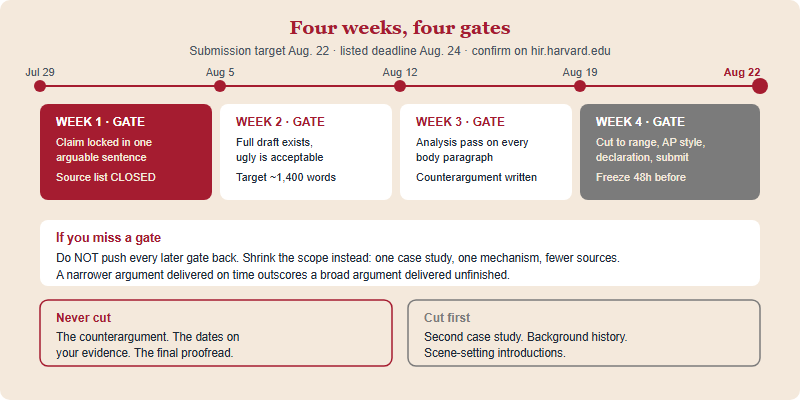
Work backwards from a submission target of Aug. 22, two days inside the listed Aug. 24 date. That buffer absorbs a portal problem, a family trip, a school registration day or a power cut, none of which the organiser is obliged to accommodate.
What to cut when you are behind, and what never to cut
Falling behind is normal. Cutting the wrong thing is what turns a delay into a weak entry. The instinct under time pressure is to protect the parts that took longest to write, which is exactly backwards: sunk effort is not the same as scoring value.
Cut these first. The second case study is almost always the right sacrifice. Two thinly handled examples score below one properly examined example, because depth of analysis is where the marks concentrate. Historical background is the next candidate: at 1,200 words you can afford one sentence of context, not a paragraph. Scene-setting openings that describe a bustling port or a glowing screen cost 80 words and earn nothing.
Never cut these. The counterargument is the first thing panicking students delete and the last thing they should touch. It carries analytical weight on the page and it is the section that makes an oral defense survivable, because you have already thought about the objection before anyone raises it. Equally, never strip the dates and sources from your evidence to save words. “Exports rose sharply” saves four words against “exports rose 34 percent between 2019 and 2023” and loses the only thing that makes the sentence evidence.
The final proofread is the third untouchable. AP Style is a stated requirement, and style marks are the cheapest marks in the contest to earn or to throw away. An hour of careful checking on number style, titles and attribution is worth more per minute than an hour of rewriting an argument you have already made adequately.
The last 72 hours: freeze, format, declare
Set a hard freeze 48 hours before your submission target. After the freeze, you are permitted to fix typos, formatting and citation details. You are not permitted to reopen the argument. Students who keep rewriting the thesis on the final evening reliably produce a version that is less coherent than the one they had three days earlier, because the last-minute change never propagates cleanly through the rest of the piece.
Use the frozen window for mechanical checks only:
- Word count inside the range. The requirement is at least 800 words and no more than 1,200, with diagrams, tables and authorship declarations sitting outside the count. Check what your word processor is actually counting.
- AP Style consistency. Numbers, dates, titles and attribution conventions applied the same way throughout, not correctly in the first half and drifting in the second.
- Authorship declaration and AI policy. The use of ChatGPT and comparable tools is prohibited, submissions are screened, and a high AI score can result in disqualification. This is also the moment to make sure that nothing you pasted from a translation tool has survived into the final text in a form you could not defend.
- File, name and portal. Confirm the required file format and submission route on the official page rather than from memory or a friend's account of last year.
One further reason to protect the frozen text: if you are selected as a finalist, you will be defending the essay you submitted, not the improved version in your head. Finalists give a 15-minute presentation and oral defense at a virtual Defense Day, listed this cycle for Oct. 5. Our guidance on that stage is in our Defense Day preparation guide, and it is much easier to follow when the submitted text and your understanding of it are the same document.
If four weeks is genuinely not enough
Sometimes the honest diagnosis is State A in late July with three weeks of school commitments in August. In that case, entering badly is the worst available option: a rushed entry produces a weak score and a stressful defense, and it consumes the topic.
The official page lists a Fall/Winter cycle with a Jan. 2, 2027 submission date and Defense Day on Feb. 5, 2027. It also states that a contestant may resubmit, but that a further submission must explore a different theme from the one originally submitted within the same contest year. Read those two facts together before you decide. If you enter now with a rushed Theme A essay, a January entry cannot be a better version of the same essay under the same theme. If you wait, you keep the choice open and you get a genuine research runway over the autumn.
Deciding this on July 29 is a strategy. Discovering it on Aug. 23 is a crisis. If you are still weighing the two windows, or you are new to how the cycles and divisions work, start with our overview of how the HIR contest works and confirm every date directly with the organiser.
Frequently asked questions
Which August date should I plan to?
The official contest page lists Aug. 24, 2026 for the Summer cycle. Plan to that date, verify it on hir.harvard.edu, and aim to submit two days early.
Is there a separate deadline for students in China?
The contest page publishes one set of cycle dates rather than regional ones. A school or programme may set an earlier internal date for collecting work.
Can I still enter if I have not started writing?
Yes, if you narrow the scope immediately to one mechanism and one case. Lock the claim and close the source list within the first week.
Can I revise my essay after I submit it?
The contest page describes resubmission as needing a different theme within the same contest year. Confirm any correction process directly with the organiser.
This is an independent guide operated by Hanlin Education for China-based international-school students. We are not affiliated with, endorsed by, or sponsored by the Harvard International Review or Harvard University. Cycle dates, word limits, style requirements and the AI policy cited here reflect the official contest page at the time of writing and can change; always confirm current details on hir.harvard.edu before you act on them. Factual errors reported to our editorial desk are corrected within 7 working days.