For the 2026 Summer cycle, the official contest page lists submissions closing Aug. 24 and Defense Day on Oct. 5 — exactly six weeks apart. Finalists give a 15-minute presentation and oral defense at a virtual event. Those six weeks fall across the start of the school year, so the students who defend well are the ones who front-load the work in early September, not late.
What the gap is, and what it is not
The moment you submit, the essay stops being a writing project and becomes a document you may be asked to defend. That is a different skill, and the six-week gap is the only time you will have to build it.
Two things about this window are widely misunderstood by first-time entrants.
Defense Day is for finalists. The contest describes Defense Day as the stage where finalists present and defend their work. Not every entrant will be invited. The contest page does not publish a notification date, so you should confirm timing with the organiser rather than assume it. The practical consequence is uncomfortable but manageable: for at least part of the gap you may not know whether you are defending, and the only sensible policy is to prepare as though you are. Six weeks of light preparation costs a few hours a week. Two weeks of panic preparation after an invitation arrives costs far more, and lands in the busiest part of the term.
The gap is not a revision window. You will be defending the text you submitted. The official page describes resubmission as an option that must explore a different theme from the original within the same contest year — that is a route to a second, different entry, not a mechanism for improving the one you already sent. If you believe you have submitted a genuine factual error, ask the organiser directly rather than assuming either that it can be fixed or that it cannot.
| After you submit, can you change… | Status | What to do instead |
|---|---|---|
| The wording of your essay | Treat as fixed | Defend the text as written; note weak phrasing so you can address it aloud |
| Your central claim | Treat as fixed | If your view has genuinely shifted, say so at Defense Day and explain why — that is analysis, not weakness |
| Your evidence base | Fixed in the essay, expandable in your head | Keep reading. New sources cannot enter the essay but can inform your answers |
| Your theme | Only via a separate entry | The official page requires a resubmission to explore a different theme within the same contest year |
| A factual error you have spotted | Unclear from published rules | Contact the organiser; do not assume. Prepare an honest correction to deliver aloud |
Build the fact sheet while the research is still fresh
Do this in the first week after submitting, while you can still remember where everything came from. By late September you will have forgotten which report the 2023 figure came from, and reconstructing it under exam-season pressure is miserable.
The fact sheet is one page. It contains every checkable element of your essay and nothing else — no argument, no prose, no rehearsed answers. Its purpose is narrow: to let you answer precisely and immediately when someone asks where a number came from.
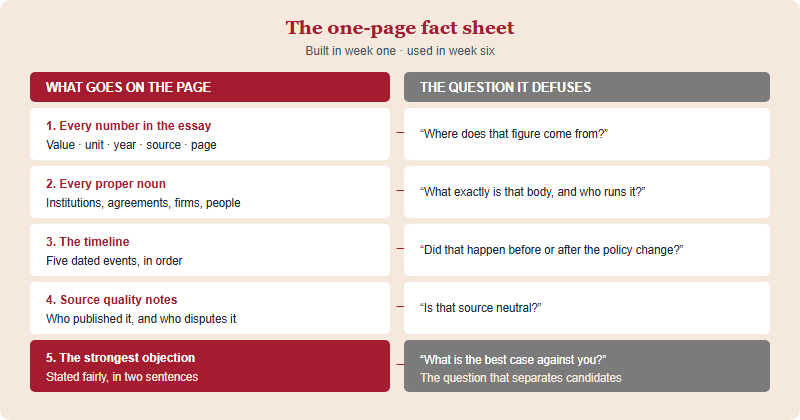
Row five is the one students skip and the one that matters most. An examiner who asks for the strongest counterargument is not attacking you; they are checking whether you understand the debate you have entered. A candidate who can state the opposing case generously, then explain precisely why the evidence still favours their reading, is demonstrating exactly the quality the contest describes as argument rather than agenda.
The objection drill: three passes over six weeks
Spread the preparation across the gap rather than compressing it into the final fortnight, which will collide with school. Three passes, roughly two weeks apart, are enough.
- Pass one, early September: the hostile read. Read your own submitted essay as though you disagree with it, pen in hand, marking every sentence a sceptic could challenge. Do not defend anything yet. Most students find four to six weak points, typically an unsourced generalisation, an over-claimed causal link, and a paragraph where the evidence does not actually reach the conclusion drawn from it.
- Pass two, mid-September: build answers, not scripts. For each weak point, prepare a two-sentence honest response. The best answers concede something real. “That figure covers only the coastal provinces, so my claim holds for those markets and I would not extend it nationally” is a strong answer. “That is a good question, and my essay shows…” is a filler phrase that examiners hear all day.
- Pass three, late September: rehearse aloud, timed. Present to someone who has not read the essay. Fifteen minutes covering presentation and oral defense is less time than it sounds, and the constraint is real: a presentation built to fill the whole slot leaves no room for questions. Our structural guidance for the session itself is in our Defense Day preparation guide.
Between passes, keep reading around your topic. New material cannot enter the submitted essay, but it can transform an answer. A candidate who can say “a report published after I submitted actually strengthens this point, and here is why” has demonstrated that the essay was the start of their thinking rather than the end of it.
Rehearsing in English without over-scripting
For students working in English as an additional language, the temptation is to write the presentation out in full and learn it. This reliably backfires. A memorised script survives the presentation and collapses at the first unexpected question, because you have practised recitation rather than thinking aloud.
A more durable approach for the final fortnight:
- Script only the first 45 seconds. Opening nerves are real. A fixed, well-rehearsed opening that states your claim and your structure buys you composure for everything after it.
- Everything else runs from a keyword outline. One line per section, five or six lines total. If you cannot present a section from one line, you do not know it well enough yet.
- Drill the transitions, not the sentences. The phrases that carry an oral defense are the connective ones: what follows from this, the objection here would be, the evidence is weaker on this point. Rehearse those until they are automatic and the content can vary freely.
- Practise saying “I do not know.” Followed by what you would need to find out. That answer scores better than a confident invention, and it is far better than an evasive paraphrase of the question.
It also helps to reread the scoring criteria once in this window rather than only before submission, because they describe what the contest values in the argument itself, which is what you will be questioned on. Our breakdown is in the 60-point rubric guide.
Working around the senior-year calendar
This is where China-based international-school students face a scheduling problem that students in other systems do not face in the same shape. The six-week gap opens during the summer holiday and closes in the middle of a very crowded autumn.
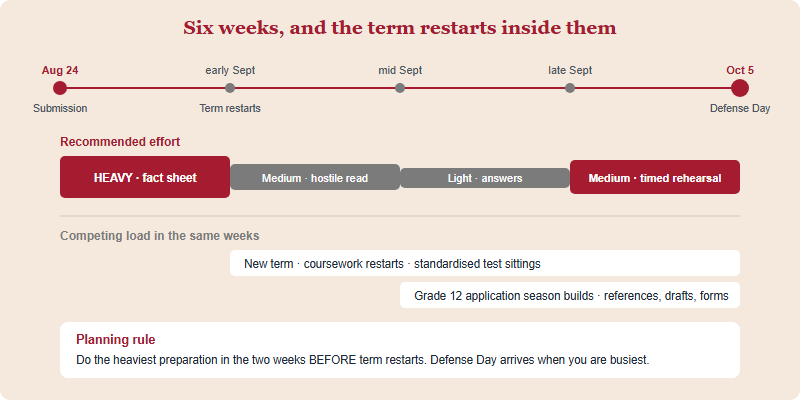
Three collisions are worth checking against your own diary now rather than in late September.
First, term restart. Most schools in China resume in early September, which means roughly two-thirds of the gap sits inside term time. The fortnight immediately after submission is the cheapest preparation time you will get all season, and it is the fortnight students are most inclined to take off.
Second, application season if you are in Grade 12. Many U.S. universities place early-round deadlines at the start of November, and UCAS sets an earlier October deadline for Oxford, Cambridge and medicine-type courses — confirm the exact dates for your cycle with each university and with ucas.com, because they move. An early-October Defense Day therefore lands squarely inside the reference-chasing, essay-drafting part of the term. That is an argument for front-loading, not for skipping.
Third, the clock on the day itself. Defense Day is virtual, and Beijing time runs 12 hours ahead of U.S. Eastern Daylight Time in early October. Depending on the session you are given, that can mean a very early morning or a late evening on a school night. Confirm your session time as soon as it is issued, tell your school in advance if it falls in lesson time, and rehearse at least once at roughly the hour you will actually present.
Should you enter the next cycle while you wait?
The Fall/Winter cycle is listed with a Jan. 2, 2027 submission date and Defense Day on Feb. 5, 2027. The contest page also states that a further submission must explore a different theme from the one originally submitted within the same contest year. Read together, that gives students in Grades 9 to 11 a reasonable autumn plan: defend the Summer entry in October, then develop a genuinely different argument under a different theme over the winter.
For Grade 12 students the calculation is different, and honesty is worth more than ambition here. A January submission sits directly on top of the regular-decision period. If your autumn is already full, one well-defended essay is a better use of the season than two rushed ones, and the second entry can wait until the picture is clearer. Whatever you decide, confirm cycle dates, eligibility and any fees on the official site — and if you are still mapping how divisions and cycles fit together, start from our overview of how the HIR contest works.
Frequently asked questions
How long is the gap between submission and Defense Day?
For the 2026 Summer cycle the official page lists Aug. 24 for submissions and Oct. 5 for Defense Day, which is exactly six weeks. Confirm on hir.harvard.edu.
Does every entrant take part in Defense Day?
No. The contest describes Defense Day as the stage for finalists. Notification timing is not published on the contest page, so prepare as though you will be invited.
Can I improve my essay during the gap?
Treat the submitted text as fixed. Further reading cannot change the essay, but it can sharpen the answers you give under questioning.
What if Defense Day clashes with school or an application deadline?
Confirm your session time as soon as it is issued, warn your school early, and front-load preparation into the fortnight right after submission.
This is an independent guide operated by Hanlin Education for China-based international-school students. We are not affiliated with, endorsed by, or sponsored by the Harvard International Review or Harvard University. Cycle dates, Defense Day arrangements, resubmission rules and eligibility cited here reflect the official contest page at the time of writing and can change; always confirm current details on hir.harvard.edu before you act on them. Factual errors reported to our editorial desk are corrected within 7 working days.