An HIR Academic Writing Contest result is a judged writing credential, not an admissions outcome. It says you researched a global-affairs question, argued it in 800–1,200 words against a published 60-point rubric, and — if you reached Defense Day — held that argument for 15 minutes under questioning. That is a narrow, verifiable claim. Making it precisely is worth more than inflating it.
Every August we read the same message from students finishing a Summer-cycle draft: if I win, what does it do for me? The honest answer has two halves. The credential itself is one short line on a list. The work behind it — a defensible claim, a body of sources, an argument you can restate aloud — is reusable in supplements, interviews and everything you write next. Students who understand that split use the contest well. Students who do not spend a year chasing a line.
State the credential precisely, then stop
Before deciding where a result belongs, be clear about what it is. Only these facts are yours to claim:
- You entered a contest run by the Harvard International Review, a student-run journal founded in 1979. HIR is not Harvard University's admissions office, and the contest is not a university admissions programme. Confirm the organiser's own description on hir.harvard.edu.
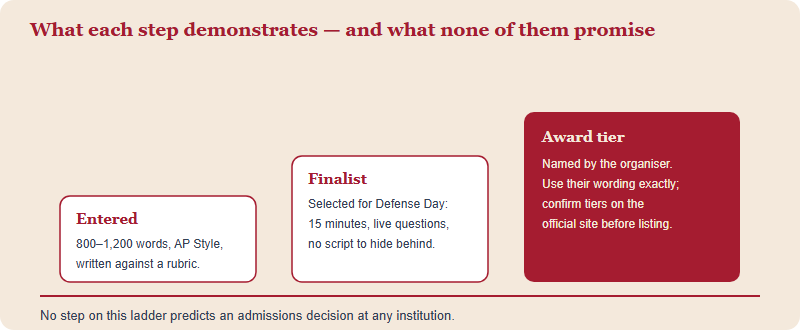
- You wrote an article of 800–1,200 words in AP Style on a set theme, in the Junior (grades 7–8) or Senior (grades 9–12) division.
- It was judged against a published 60-point rubric — 30 points of Content, 30 of Style. If that split is new to you, read our breakdown of the 60-point rubric before you write another word.
- If you were selected as a finalist, you were invited to a virtual Defense Day: a 15-minute presentation and oral defence in front of HIR judges.
- If you received an award tier, name it exactly as the organiser names it. Do not paraphrase a tier into something grander. Confirm current tier names on the official site.
The most common overclaim we see in draft activity lists is a single word: writing Harvard alone, so a reader assumes the university conferred the honour. It did not. Naming the journal in full is not modesty; it is the difference between a credential a reader trusts and one they quietly discount. For the full picture of who runs the contest and how it works, see our foundation guide to the HIR Academic Writing Contest.
What it cannot do
No writing contest result guarantees or predicts admission anywhere. Selective admissions is holistic, institution-specific and re-decided every year by people who never publish a formula. Any adult who tells a 16-year-old that one essay contest changes an outcome is selling something.
What a result can do is narrower and still valuable. It is third-party evidence that someone outside your school read your writing and rated it against stated criteria. School grades are internal; a rubric-scored external result is not. That is the entire mechanism, and it is enough. Treat it as one data point in a picture you are building over two or three years, not as a verdict.
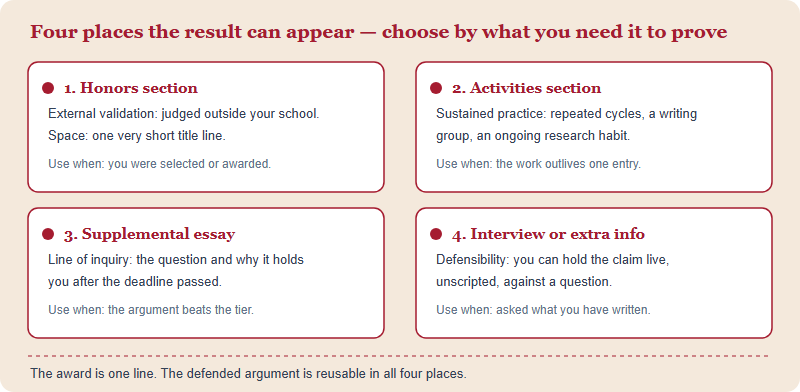
Where it goes, and what each placement says
Application forms differ by system and change between years, so treat the space estimates below as shape, not specification — check the current form for exact entry counts and character limits. What does not change is the logic: each slot answers a different question.
| Placement | Question it answers | What it rewards | Best fit |
|---|---|---|---|
| Honors / awards list | Has anyone outside your school rated this work? | Selection and named tiers, stated plainly | Finalists and award recipients |
| Activities list | Is writing something you actually do? | Repetition across cycles, a club, a mentee you coach | Students entering more than once, or leading a writing group |
| Supplemental essay | What do you think about, unprompted? | The substance of your claim, not the outcome | Anyone, including entrants who were not selected |
| Additional information | Is there context a reader needs? | Brief factual notes; a link where permitted | Rarely — only if the credential is genuinely unclear |
| Interview | Can you defend it in conversation? | Two minutes of clear, unrehearsed reasoning | Everyone who wrote a real argument |
Notice which row does the most work for the most people. Three of the five do not require a trophy at all. If you are reading this in the run-up to the Summer submission date the site lists as Aug. 31, 2026, that is the useful news: the return on this contest starts the moment you have a defensible article, not the moment results are announced.
How to phrase it without overclaiming
Short fields punish vagueness and reward specificity. Some patterns to avoid, and the versions that survive scrutiny:
- Avoid: “Harvard writing award, 2026.” Write: “Harvard International Review Academic Writing Contest — [tier as named by the organiser], Senior Division, 2026.”
- Avoid: “Top 1% globally” or any ranking figure you cannot source. Write: only what the organiser publishes about your result.
- Avoid: “Published by Harvard.” Write: describe publication exactly as it occurred, and only if it occurred; confirm what publication, if any, accompanies a result on the official site.
- Avoid: “International essay competition finalist.” Generic titles read as padding. Write: the contest's full name plus your division.
- Consider adding your topic where space allows: “Finalist, HIR Academic Writing Contest (Senior) — article on how one procurement rule reshaped a regional supply chain.” The topic is what a reader remembers.
One further discipline: if you were not selected, do not list the entry as an honour. An unselected entry is not a credential — it is raw material, and it is genuinely good raw material. Move it to a supplement, a portfolio, or the interview answer where it belongs.
The part that outlives the result
Defense Day is the most transferable thing in this contest, and most entrants underuse it. Fifteen minutes of presenting a claim and then absorbing questions from judges is structurally the same exercise as an alumni interview, a viva-style university interview, or the first tutorial of a British degree: state a position, take the objection seriously, revise or hold with reasons. Students who rehearse for it — see how to prepare for Defense Day — report that the second time they do it, in a completely different room, they are noticeably calmer.
Practically, one finished entry converts into at least four assets:
- A supplement paragraph. “I spent six weeks trying to work out why X happens, and the answer I found was less satisfying than the one I started with” is a real intellectual-curiosity essay, and it is true.
- An interview answer. Ninety seconds on a claim you have already defended beats three minutes of improvisation on a subject you half-remember.
- A writing sample. Where a programme or scholarship invites one, an 800–1,200 word rubric-tested article is a cleaner sample than a 4,000-word school essay.
- The next project. The best follow-up topic is usually the objection you could not fully answer at Defense Day.
Compounding across two cycles
One credential is a dot. Two related entries make a line, and a line is what reads as genuine interest. The site lists three cycles — Spring, Summer and a Fall–Winter window whose submission date and Defense Day are published on hir.harvard.edu (confirm all dates there). A student who enters the Summer cycle on a narrow question and returns in the Fall–Winter cycle on the follow-up question has produced something a scattergun activity list cannot fake.
Two cautions on that plan. First, a second entry should narrow, not repeat — the same argument resubmitted is not a line of inquiry, and you should confirm with the organiser whether a previously submitted article may be entered again at all. Second, the contest forbids AI-generated text and runs entries through AI checkers, so the compounding has to be real work done by you, cycle after cycle. That constraint is the whole reason the credential means anything.
Questions students actually ask
Does winning guarantee admission to Harvard or any other university?
No. It is a writing credential judged by a student-run journal. No contest result guarantees or predicts an admissions decision anywhere.
Can I just write “Harvard” in my honors title?
No. Name it in full: the Harvard International Review Academic Writing Contest. HIR is a student-run journal, not the university's admissions office.
Is it worth listing if I was not selected as a finalist?
List only selected or awarded results. An unselected entry still works as a writing sample, a supplement topic, or an interview answer.
Does Defense Day count as a university interview?
No. It is a 15-minute presentation and oral defence before HIR judges — excellent rehearsal, but unconnected to any university's admissions process.
This is an independent guide operated by Hanlin Education for China-based international-school students. We are not affiliated with, endorsed by, or sponsored by the Harvard International Review or Harvard University. Contest rules, dates, divisions, fees and award terminology are set by the organiser and can change — confirm current details on hir.harvard.edu before you rely on anything here. Errors reported to our editorial desk are corrected within 7 working days.