The most common request we get about this contest is for “past winning essays.” They do not exist in public. The organiser publishes medal winner lists giving student name, school and article title — not the articles themselves. That changes what preparation can look like, and it turns out the lists are still genuinely informative, provided you read them for the right thing: scope.
This is worth settling whether you have just submitted to a cycle or are planning the next one. Cycle dates, including the late-August summer submission date, should be confirmed on hir.harvard.edu rather than taken from any secondhand source — and the same principle applies to what is and is not published about winners.
What is actually published, and what is not
The organiser posts medal winner pages after cycles conclude. Their format is consistent and minimal: for each winner, a name, a school, and the title of the article, grouped by medal. No text, no excerpts, no links to the entries themselves.
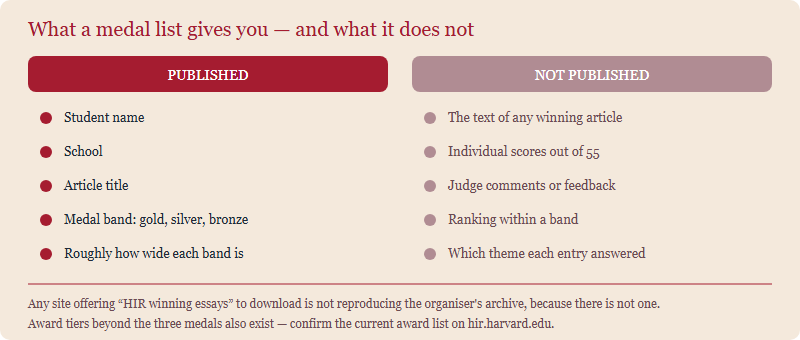
One consequence deserves saying plainly. Because no official archive exists, anything advertised online as a downloadable pack of “HIR winning essays” is either somebody's own submitted work, a reconstruction, or something invented. Building your preparation on a text of unknown provenance is a poor idea on quality grounds alone, before you reach the originality problem below.
Three things you can genuinely read off a medal list
First, the shape of the bands. The medals are not three near-identical prizes; the lists widen sharply as you go down. On one recent cycle's list the bronze band ran to roughly three times as many names as the gold band. Do not carry that ratio forward — counts differ by cycle, and counting the list for your own cycle takes two minutes. The general point holds regardless: a medal of any colour puts an entry in a recognised band, and the distances between bands are real. Our separate guide to the award tiers covers what each level does and does not signal.
Second, the school spread. Scan the school column and you will see a genuinely international field — schools across Asia, North America, Europe and elsewhere, including a steady presence of international schools in Greater China. This is more useful than it sounds. Students in China frequently assume that a contest run out of a Harvard student journal is effectively a domestic U.S. competition with a token international entry. The list does not support that reading. Our guide to the contest as a whole covers the eligibility position; the winner lists are the empirical version of the same point.
Third, and most valuable: the titles show you what “narrow enough” looks like. Scope is the single hardest judgment in an 800–1,200 word article, and a full medal list is a long set of worked examples of scoping decisions made by entries that cleared the bar. Read the titles as a set and the pattern is unmistakable.
| Title pattern | Illustrative form (constructed, not quoted) | What the scope tells you |
|---|---|---|
| Named case + mechanism | “Port Concessions and Debt: How One Lease Reshaped a Trade Corridor” | One case, one causal claim — the most common winning shape |
| Policy instrument, not policy area | “What Export Licensing Did That Tariffs Could Not” | The argument lives in a specific tool, not in a whole domain |
| Counterintuitive finding | “The Subsidy That Raised Prices” | A tension stated in the title; the article has something to prove |
| Two-case comparison | “Two Basins, Two Drought Clauses, One Difference That Mattered” | Comparison as method, bounded to two cases — not five |
| Region + specific pressure | “Coastal Manufacturing After the Shipping Reroute” | Geography narrowed by an event, not by a continent |
| Rare or absent | “The Future of Globalisation” · “Climate Change and Society” | Whole-domain titles do not survive 1,200 words, and the lists reflect that |
The examples above are constructed to show the patterns rather than reproduce anyone's title. The exercise to actually do is simple: open the medal list for a recent cycle, read the medal-winning titles for that cycle in one sitting, and note how many name a specific case, instrument or contradiction, versus how many name a field. Then hold your own working title against that distribution. It is the cheapest scoping check available, and it uses information the organiser genuinely publishes.
What to read instead: the journal itself
Here is the part students miss. The contest is run by the Harvard International Review, and the HIR is a working publication — a student-run journal founded in 1979 that publishes its own articles on international affairs. Those articles are public, and they are written in the house style and at roughly the register the contest is asking for.
That is a much better model than a hypothetical winning entry would be, for three reasons. The articles are professionally edited, so the AP-Style conventions are applied consistently rather than approximately. They are the publication's own idea of what good writing on international affairs looks like, which is the standard the contest grew out of. And there is no ambiguity about whether you are allowed to read them.
Two cautions. HIR articles are not contest entries: they are often longer than 1,200 words, are written by the journal's own contributors rather than by contest entrants, and are not written to a 60-point rubric. So study the prose, not the format — sentence rhythm, how a claim is introduced, how evidence is attributed inside the paragraph, how a counterargument is conceded without collapsing. For the shape of a contest entry, use the rubric and word limit instead; our reading of the 60-point rubric sets out what each line rewards.
The 20-minute reverse outline
Reading a good article teaches you nothing unless you take it apart. A reverse outline is the standard method: you reconstruct the skeleton of a finished piece from the outside, recording structure rather than content. Twenty minutes per article, three or four articles, and you will have internalised more about house style than a term of general advice delivers.
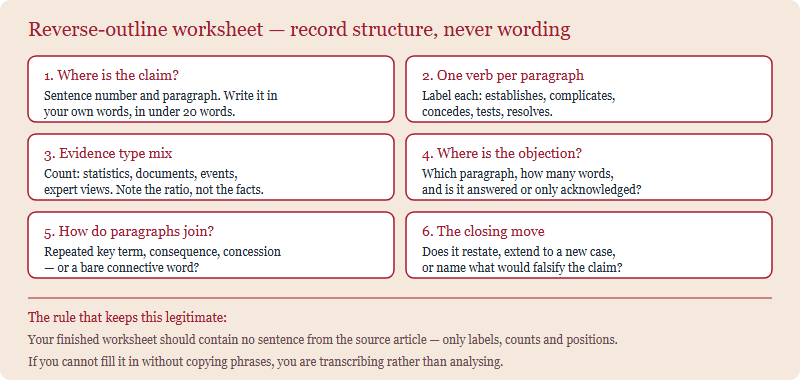
Do three or four articles this way and patterns emerge quickly: how early a claim tends to appear, how much space a concession typically gets, how often a paragraph opens on a term from the previous one. Those are the transferable findings. Then set the worksheets aside before you draft — the point is to have absorbed a shape, not to have a template open beside you.
The line between learning and copying
Everything above sits inside a hard constraint: entries must be your own original work, submitted with the required declaration, and AI-generated text is prohibited. Those are compliance requirements — confirm the current wording on hir.harvard.edu — and they define what “learning from winners” can legitimately mean.
| You may take | You may not take |
|---|---|
| Structural patterns — where the claim sits, how a concession is placed | Sentences or phrases, however lightly reworded |
| The observation that narrow scopes do better | Someone's claim, rewritten as your own thesis |
| Register and tone as a general target | A source list assembled by another writer, reused unchecked |
| Question types worth asking of your own case | A title pattern filled in with a case you have not researched |
| Awareness of what a medal band contains | Any text produced or rewritten by an AI tool |
Two failure modes are worth naming because they are subtle. The first is topic mimicry: seeing that maritime-security entries appear on a list and choosing maritime security without a case you can actually research. Themes and judging panels change; imitating last cycle's subject buys you nothing while costing you the topic you knew something about. The second is laundering through a chatbot — feeding a model an article and asking for “something similar in my own words.” That is prohibited text by the plainest reading of the rule, it produces derivative work, and it puts you in front of a 15-minute oral defense holding an argument you did not build. Entries are screened, and the exposure runs both ways.
The honest version of this exercise is unglamorous and it works: read titles to calibrate scope, reverse-outline published prose to calibrate style, then write about something you can defend under questioning. That last condition is the real filter — an argument assembled from other people's shapes tends to fall apart the moment a judge asks why you believe it.
Questions students actually ask
Where can I read past winning HIR contest essays?
You cannot. The organiser publishes winner names, schools and article titles only — no entry text, scores or judge feedback. Confirm what is posted on hir.harvard.edu.
So what is the point of the winners list?
Scope calibration. A cycle's full list of medal-winning titles shows you how narrow a topic has to be to work inside 800–1,200 words.
What should I read as a style model instead?
The Harvard International Review's own published articles. They are public, professionally edited, and written in the house style the contest asks for.
Can I use an AI tool to summarise articles while researching?
Do not risk it for anything touching your text. AI-generated writing is prohibited and entries are screened — confirm the current rule on hir.harvard.edu.
This is an independent guide operated by Hanlin Education for China-based international-school students. We are not affiliated with, endorsed by, or sponsored by the Harvard International Review or Harvard University. All example titles in this article are constructed for illustration and are not reproductions of any published or submitted work. What the organiser publishes about winners, along with award tiers, cycle dates, originality rules and the AI policy, is set by the organiser and can change — confirm current details on hir.harvard.edu before you rely on anything here. Errors reported to our editorial desk are corrected within 7 working days.