If you write about East Asia from a school in China, your best evidence is often not in English: a ministry release, a provincial statistical bulletin, a Chinese-language investigation with reporting no wire service repeated. This is not a question of whether those sources are credible. It is a question of what happens when a credible source crosses a language boundary on its way into an 800-1,200 word AP-style essay you may have to defend out loud if you are selected as a finalist.
The language boundary is a scoring problem, not an admin problem
Students treat non-English sources as a formatting nuisance — something to be tidied at the end. It is not. Three of the things the rubric scores run straight through the language boundary.
Use of evidence. A judge assessing whether your evidence supports your claim needs to be able to identify what the source is. A bare Chinese-language link with no English description is, from the reader’s side, an unidentifiable object. It may be the single best document in your bibliography and still earn nothing, because nobody can tell.
Analysis of evidence. Translation is interpretation. When you render an official phrase into English you have already made an analytical choice about what it means, and if you make that choice carelessly the analysis built on top of it inherits the error.
Style. AP Style has settled conventions for names, places and numbers. Non-English material is where those conventions are most often broken, and where inconsistency — the same institution appearing under three different English names in one essay — is most visible.
And then there is Defense Day, which HIR runs for selected finalists: a fifteen-minute presentation and oral defense in which a reader can ask you what a source actually said. That single fact should govern every decision below: never put a translated phrase in your essay that you could not reconstruct and justify out loud. If the structure of the contest is still new to you, our complete guide to how the contest works sets out the rest of it.
First decision: the original, or the English relay?
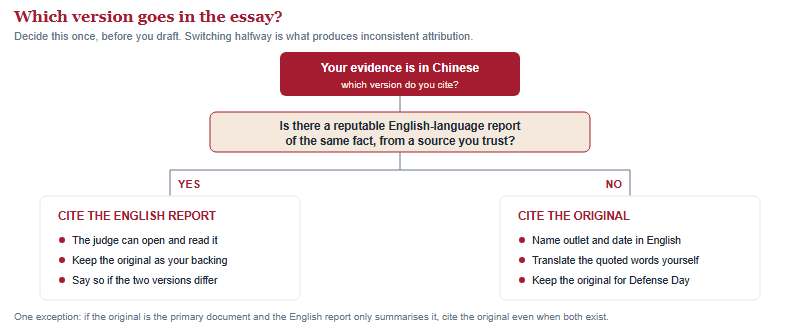
Most of the time, if a reputable English-language outlet has reported the same fact, cite that. This is not a concession to laziness — it is the same verifiability principle that governs every other source decision. Your reader should be able to check you.
But there is a real exception, and it is the case where your essay gains something no other entry has. When the Chinese document is the primary evidence — the regulation itself, the statistical table, the local reporting nobody translated — citing an English summary of it means citing someone else’s reading rather than the thing. In that situation, cite the original, and carry the extra work that comes with it.
What you should never do is mix the two invisibly: quote an English article’s paraphrase while implying you read the ministry document, or cite the ministry document for a figure you actually took from a news summary. Both are attribution errors and both are the kind of thing that surfaces badly under questioning.
Translating a quotation you will have to defend out loud
Assume a judge may ask: what were the actual words? Four practices make that a comfortable question rather than a bad one.
- Translate the shortest defensible unit. The longer the passage you render into English, the more interpretive choices you are quietly making. A ten-word quotation you can justify word by word is worth more than a forty-word one you cannot.
- Signal that it is a translation. AP-style running attribution gives you room: “in a statement released in October, the ministry said, in translation, that…” One phrase, and the reader now knows exactly what kind of object they are looking at.
- Paraphrase in preference to quoting, when the wording is not the point. If you are using the source for a fact rather than for its language, a clean English paraphrase with proper attribution is more honest and costs fewer words. Reserve direct quotation for cases where the specific phrasing carries the argument.
- Flag genuinely contested terms rather than smoothing them. Official and administrative vocabulary sometimes has no clean English equivalent, and choosing one silently is an analytical decision hidden inside a style decision. Naming the difficulty in half a sentence is a mark of care, not weakness — and it is a sentence you would rather have written than have to improvise at the defense.
On machine translation, be straight with yourself. The contest prohibits AI-written work. HIR’s published wording is broad — it states that the usage of ChatGPT and other AI tools and software is strictly prohibited — and it does not carve out translation software, so read the current rule on hir.harvard.edu and treat the breadth of that wording as a reason for caution rather than a loophole. The defensible practice is straightforward: the essay is your writing, the translation of any words you quote is your work, and you can reconstruct how you arrived at it. Given how broadly the prohibition is worded, the safe course is to do the reading and the translating yourself and to be able to explain each choice, rather than to assume a tool used at the research stage sits outside the rule.
Names, places and institutions: consistency beats memory
AP maintains entries for Chinese personal names and place names, and the practical instruction is the boring one: look them up in the current stylebook rather than trusting what you have seen elsewhere, because English-language usage varies and some of what you have seen is wrong or out of date. The convention most English-language newsrooms follow for mainland Chinese personal names is family name first without a comma, in pinyin — verify the current entry before you rely on it, and note that names from Hong Kong, Taiwan and the diaspora often follow different established spellings that are not pinyin.
Three habits will keep you out of trouble regardless of what any individual entry says:
Gloss on first mention, then be consistent. Give the reader an English handle the first time an institution appears — what it is, what level of government or which sector — then use one form of the name for the rest of the essay. An institution that appears as three different English names reads as three different institutions.
Pick one romanization system and stay in it. Mixing pinyin with older spellings inside one paragraph is an easy style error to make if you grew up around both.
Do not translate a name that has an established English form. If an institution publishes in English under a particular name, use that name. Inventing your own translation of an organisation that has an official English title makes the source harder to find, which is the opposite of what attribution is for.
The scale trap: numbers that cross a language boundary
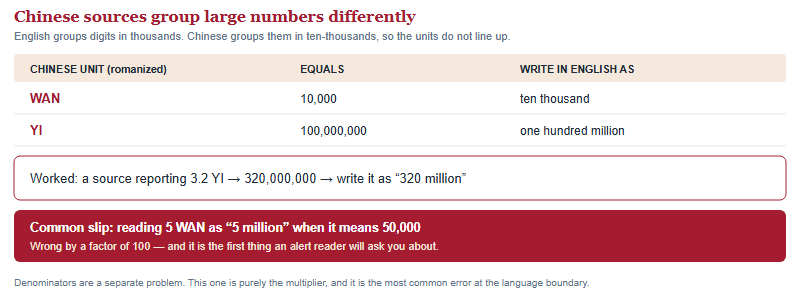
English writes large numbers in groups of three and names the groups thousand, million, billion. Chinese groups in fours and has its own unit names, and the two systems do not align. It is a common and entirely avoidable factual error in student essays that use Chinese-language statistics.
| Unit as printed | Romanized | Numeric value | Correct English | The trap |
|---|---|---|---|---|
| 万 | wan | 10,000 | ten thousand | Frequently misread as “million” (100× too large) |
| 百万 | bai wan | 1,000,000 | million | This, not the row above, is “million” |
| 千万 | qian wan | 10,000,000 | ten million | Reads like “thousand” to an English eye |
| 亿 | yi | 100,000,000 | one hundred million | Not “billion” — it is one tenth of one |
| 万亿 | wan yi | 1,000,000,000,000 | trillion | Common in budget and GDP reporting |
Two further checks belong in the same pass. Fiscal and reporting periods. A figure covering January to September is not an annual figure, and a first-half number is not a full-year number; make sure your English sentence says which period it covers. Currency and units. If your source reports in yuan and your comparison is in dollars, say which currency the figure is in rather than silently converting, and if you do convert, say what rate and what date you used — an exchange rate is itself a dated fact.
None of this is about the denominator problem — whether a rate is per capita, per household or per thousand is a separate discipline. This is purely the multiplier, and the reason it deserves its own section is that a factor-of-100 error is not a style blemish. It is the kind of error that makes a reader distrust every other number in the essay.
A bilingual evidence list a judge can actually check
Whatever form of reference list you use, remember who is reading it: someone who may not read Chinese and may not be able to open every link from where they are. The job of the entry is to let that person identify the source even if they cannot read it. Record the following for every non-English item.
| Record | Why the reader needs it |
|---|---|
| Publisher or outlet, in English | Tells the reader what kind of source it is — official, commercial, academic |
| Date of publication | Lets them judge whether the evidence is current, and lets you date-stamp the claim |
| A short English rendering of the title | Makes the item identifiable and searchable to a non-reader of Chinese |
| Document type | A regulation, a statistical release and a news report carry different weight |
| Whether an English version exists | If the publisher issues one, point to it — it is the most checkable form |
| Your own note on any translated phrase used | Private working note; this is what you revise from before the oral defense |
Keep that last row seriously. The gap between drafting and the defense is long enough that you will not remember why you rendered a particular official phrase the way you did, and “I do not recall” is the one answer you cannot afford when the question is about your own evidence. Our Defense Day preparation guide covers rehearsal in general; if your essay leans on Chinese-language sources, add one specific exercise to it — have someone point at each translated phrase and ask you to justify the English word you chose.
Done properly, all of this is an advantage rather than a burden. Most entries in an international affairs contest are built from the same English-language sources everybody else can reach. An essay that uses primary material in another language, handled with visible care, is doing something the field genuinely values — and it gives you something to say when a judge asks where your evidence came from. That care is also what the style half of the 60-point rubric is measuring: not elegance for its own sake, but the discipline that lets a reader trust what you put in front of them.
Frequently asked questions
Can I cite Chinese-language sources in an HIR essay?
Nothing in the published rules we have seen forbids it. Give enough English detail that a reader can identify the source, and confirm current requirements on hir.harvard.edu.
Should I quote the original characters in the essay?
Rarely. Quote the English translation, signal that it is a translation, and keep the original in your own working notes.
Is using a translation tool on a source against the AI rule?
HIR states that the usage of ChatGPT and other AI tools and software is strictly prohibited, with no carve-out for translation software. Do the translating yourself and confirm the current rule on hir.harvard.edu.
What is the most common numerical mistake?
Reading the unit “wan” as million. It means ten thousand, so the error is a factor of 100 and it discredits your other figures.
This is an independent guide operated by Hanlin Education for China-based international-school students. We are not affiliated with, endorsed by, or sponsored by the Harvard International Review or Harvard University; the HIR is a student-run journal founded in 1979 and is not an official Harvard University publication. Style requirements, source rules, the policy on AI assistance and all cycle details are set by the organiser and change between cycles — confirm current details on hir.harvard.edu before you rely on anything here. Errors are corrected within 7 working days of being reported.