If English is not your first language, the hardest part of HIR Defense Day is rarely the argument. It is saying that argument out loud, in real time, to a judge whose next question you cannot predict. The fix is not a more polished script. It is a small set of speaking habits you can build in the three weeks before the Summer cycle’s Oct. 5 Defense Day, and those habits are what this guide covers.
What HIR says the day decides
The contest page on hir.harvard.edu says little about Defense Day, but three sentences matter to anyone speaking in a second language. A number of contestants are selected as finalists and invited to a virtual HIR Defense Day to give “a 15-minute presentation and oral defense” to Harvard International Review judges. Finalists are eligible for gold, silver and bronze medals “based on their scores and performance in the HIR Defense Day.” And judges conduct “even more careful review and assessment during the interview stage to ensure authenticity of work.”
So the medal is not settled by the essay alone, and the questions are partly an authenticity check. The essay’s score comes from the Evaluation Rubric in HIR’s submission guide, which our rubric walkthrough explains; how the day’s performance is weighed, the page does not say. Nor does it mention accent or native fluency. The real risk for a second-language speaker is a visible gap between the confident English of your essay and a hesitant spoken explanation of the same ideas. A judge cannot see your drafts, but can hear whether you reach your own reasoning.
The page also leaves out how the fifteen minutes divide between presenting and questions, which platform is used, whether slides are expected and when your session starts. Confirm those with HIR, on hir.harvard.edu or at contest@hir.harvard.edu. For the content of your defense, start with our Defense Day preparation guide; this article covers only the speaking.
The speaking repays the effort for one more reason. Because medals go to finalists, a medal from this contest already includes a live defense of the work. Set beside a writing sample and teacher comments in an application, each piece corroborates the others, and that makes the award easier to believe.
Written English and spoken English are different jobs
Your essay was built for a reader who can reread. A judge hears each sentence once. What works on the page — long noun phrases, stacked clauses, a citation carried by a hyperlink — is hard to follow aloud and harder to produce accurately when you are nervous. The conversion is mechanical, which means you can practice it.
| On the page | Out loud | Why it changes |
|---|---|---|
| A 35-word sentence with two subordinate clauses | Two or three sentences of 10 to 15 words, main verb early | A listener cannot scroll back to find the subject |
| A citation carried by a hyperlinked word | The source named aloud: “According to [the organization]’s report last year…” | A link is invisible in speech; attribution still has to be heard |
| An exact figure such as 3.47 percent | “About three and a half percent,” with the exact figure ready if asked | Decimals are easy to mishear and to misspeak |
| Structure carried by paragraphs and transitions | Structure announced: “Two reasons. The first is…” | Spoken signposts replace the paragraph break |
| Impersonal phrasing: “It can be argued that…” | Owned phrasing: “My argument is…” or “The evidence suggests…” | The judge is asking what you think, in person |
Take one sentence. Imagine your essay says: “The limited repair capacity of regional operators, rather than deliberate sabotage, constitutes the more significant vulnerability for small states dependent on a single undersea cable.” Spoken, it becomes: “My argument is about repair, not sabotage. Cables get damaged. What turns damage into a long outage is how long the repair takes. For a small state with one cable, that wait is the real risk.” Same claim, four sentences you can say correctly under pressure.
In rehearsal, the most common problem we see is not vocabulary. It is reading polished essay sentences aloud and losing the thread halfway through a clause. The ideas transfer to speech; the sentences do not.
Shape every answer before you start talking
Questions are where second-language speakers most often lose control, and rarely for lack of an answer. Long answers drift: the grammar gets harder to hold, the point arrives late, and the judge is left unsure what was claimed. A fixed shape prevents that.
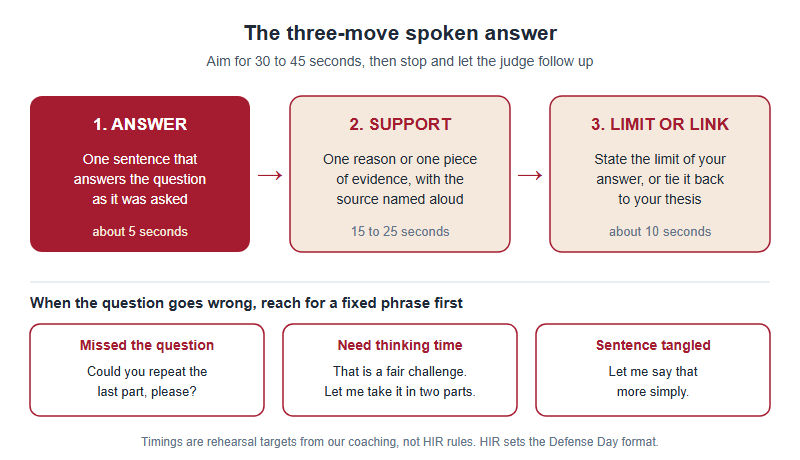
Answer the question as asked, in one sentence, first. Support it with one reason or one piece of evidence, naming the source aloud. Then state the limit of your answer or tie it back to your thesis, and stop. Thirty to 45 seconds is a sensible target; if the judge wants more, they will ask, and a follow-up is a better use of fifteen minutes than a monologue.
Learn the rescue moves as fixed phrases, so that none of them has to be composed on the spot.
| Situation | Say | Avoid |
|---|---|---|
| You did not catch the question | “Sorry, could you repeat the last part?” | Guessing, then answering a different question |
| You heard it but are unsure what is asked | “Just to check: are you asking whether X, or whether Y?” | A long answer to the question you hoped for |
| You need a few seconds | “That is a fair challenge. Let me take it in two parts.” | Silence, or a string of fillers |
| The judge has a point | “You are right that X. Where I would still hold my position is Y, because Z.” | Agreeing, then repeating your original point unchanged |
| You do not know | “I did not look at that. From the evidence I did use, my best reasoning is…” | Inventing a figure or a source |
| A sentence has tangled | “Let me say that more simply.” | Apologizing for your English |
Never apologize for your English. It invites the listener to judge your language instead of your reasoning, and “let me say that more simply” does the same repair work. Likewise, an honest “I did not look at that,” followed by reasoning from what you did study, is exactly what an authenticity review is designed to surface, and far safer than a confident guess that collapses on the follow-up.
Pronounce the fifteen words your argument depends on
You do not need to sound like a native speaker. You do need the words that carry your argument to be recognized the first time. That is a short list, and you can build it from your own essay in about twenty minutes.
- Names. Every person, place and organization you mention. Check each in a dictionary with audio, or listen to an English-language broadcaster; place names often have an established English pronunciation that differs from the local one.
- Numbers. Fifteen and fifty differ mainly in stress: fif-TEEN, FIF-ty. A judge who hears 50 percent where you meant 15 hears a different claim.
- Measures. Say “percentage points” when that is what you mean. HIR’s submission guide reminds writers that percent is not the same as a percentage point.
- Thesis terms. The two or three words in your central claim will be repeated by you and by the judges. Say them the same way every time.
For speakers whose first language is Mandarin, three patterns are worth a specific check because they affect meaning rather than accent. A dropped final consonant can turn “changed” into “change” or a plural into a singular. Stress separates related words: ec-o-NOM-ic, e-CON-o-my. And stressing every word equally hides the one that carries your point. None of this needs accent training, only recording your own sentences and listening back.
One drill does most of the work. Record a two-minute spoken summary of your essay, transcribe it, and mark every sentence over 20 words, every word a listener might mishear and every pause where you searched for a word. Those marks become your shortening list, your pronunciation list and your list of ideas not yet in speakable English.
Nineteen days to Oct. 5: a plan that fits a holiday week
Two calendar facts shape the next three weeks. HIR’s contest page lists the Summer 2026 Defense Day as Oct. 5, 2026, a Monday. In mainland China that date falls inside the National Day holiday, which runs Oct. 1-7 in 2026 under the State Council’s published schedule. No lessons are missed, but there may be travel, relatives, unfamiliar Wi-Fi and no quiet room.
HIR’s page does not give session times. If your time is given in U.S. Eastern time, Beijing is 12 hours ahead of Eastern Daylight Time in early October, so a Massachusetts morning is your evening. Confirm the time zone of your slot as soon as it arrives, and rehearse once at that hour, on the device, in the room and on the network you will actually use.
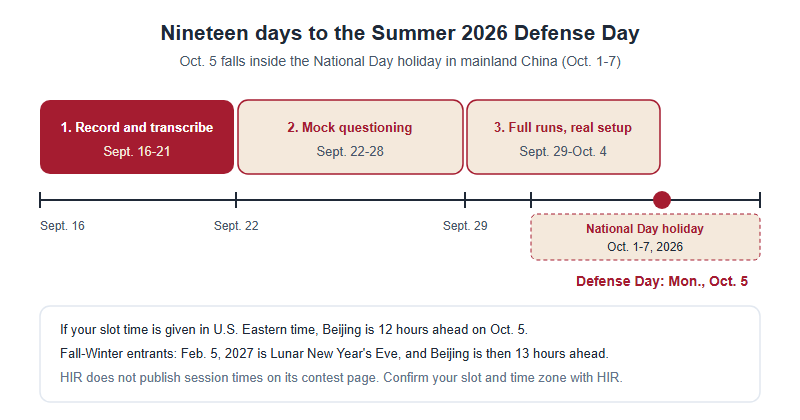
- Sept. 16-21: record and transcribe. Make the two-minute recording, build the pronunciation list and rewrite your key sentences for the ear. Five practice answers are enough at this stage; you are diagnosing, not performing.
- Sept. 22-28: mock questioning. Have a teacher or classmate question you twice, choosing the questions themselves. Record both sessions and replay them with the phrase bank beside you. Keep the roles clean: the questions come from them and the answers come from you.
- Sept. 29-Oct. 4: full runs on the real setup. Time the presentation plus questions at least twice, once at your actual session hour. Settle the logistics before Oct. 1, when holiday plans tend to take over, and keep the final day light.
Fall-Winter entrants should note their own dates now. HIR lists that cycle’s Defense Day as Feb. 5, 2027, which is Lunar New Year’s Eve, and U.S. Eastern time will then be on standard time, putting Beijing 13 hours ahead. China’s 2027 holiday arrangement had not been published at the time of writing; the 2026 schedule came out in November 2025. Speaking habits take weeks to become automatic, so start in December rather than late January. Our complete guide to the contest explains how the three cycles fit together.
Frequently asked questions
Will HIR judges mark me down for my accent?
The contest page lists no accent or fluency criterion. It says medals reflect scores and Defense Day performance, so aim to be clear, not native.
Can I read from a script at Defense Day?
The page does not address notes, but judges review authenticity at the interview stage. Speak from a short outline rather than reading sentences.
What should I do if I do not understand a question?
Ask the judge to repeat it, or restate it in your own words and check. A clarifying question costs seconds; a wrong answer costs more.
When is the Summer 2026 Defense Day?
HIR lists Oct. 5, 2026, inside the Oct. 1-7 National Day holiday in China. Confirm your own slot time and time zone when it is issued.
This is an independent guide operated by Hanlin Education for China-based international-school students. We are not affiliated with, endorsed by, or sponsored by the Harvard International Review or Harvard University; the HIR is a student-run journal, not an official Harvard University publication. Defense Day format, session times and cycle dates are set by the organiser and can change — confirm current details on hir.harvard.edu. Errors are corrected within 7 working days of being reported.