This is an independent preparation guide, not affiliated with or endorsed by Harvard International Review or Harvard University.
The Harvard International Review (HIR) Academic Writing Contest challenges students to produce nuanced analysis on global issues. A common stumbling block in this process is encountering credible sources that disagree with one another. For the 2026 Fall/Winter Cycle, where Senior Division topics range from Security in a Multipolar World to Technology, Innovation, and Power, conflicting data or interpretations are inevitable. The difficulty is not merely finding information, but synthesizing contradictory accounts into a coherent argument without appearing confused or biased.
This guide addresses the specific reasoning failure of “source paralysis” or “cherry-picking,” distinct from the broader prompt-answering guidance in When Your HIR Essay Is a Fact Tour: A Three-Layer Test for Answering the Prompt. Where that article helps students avoid dumping disconnected facts, this one focuses on what to do when reputable sources themselves clash. We examine how to handle disagreement between institutions, such as when a government report contradicts an NGO assessment or when two think tanks offer divergent predictions on digital culture trends.
Teaching Illustration 1: Mapping the Disagreement
The following case is an original teaching illustration, not an official past-paper question or claimed marking criterion.
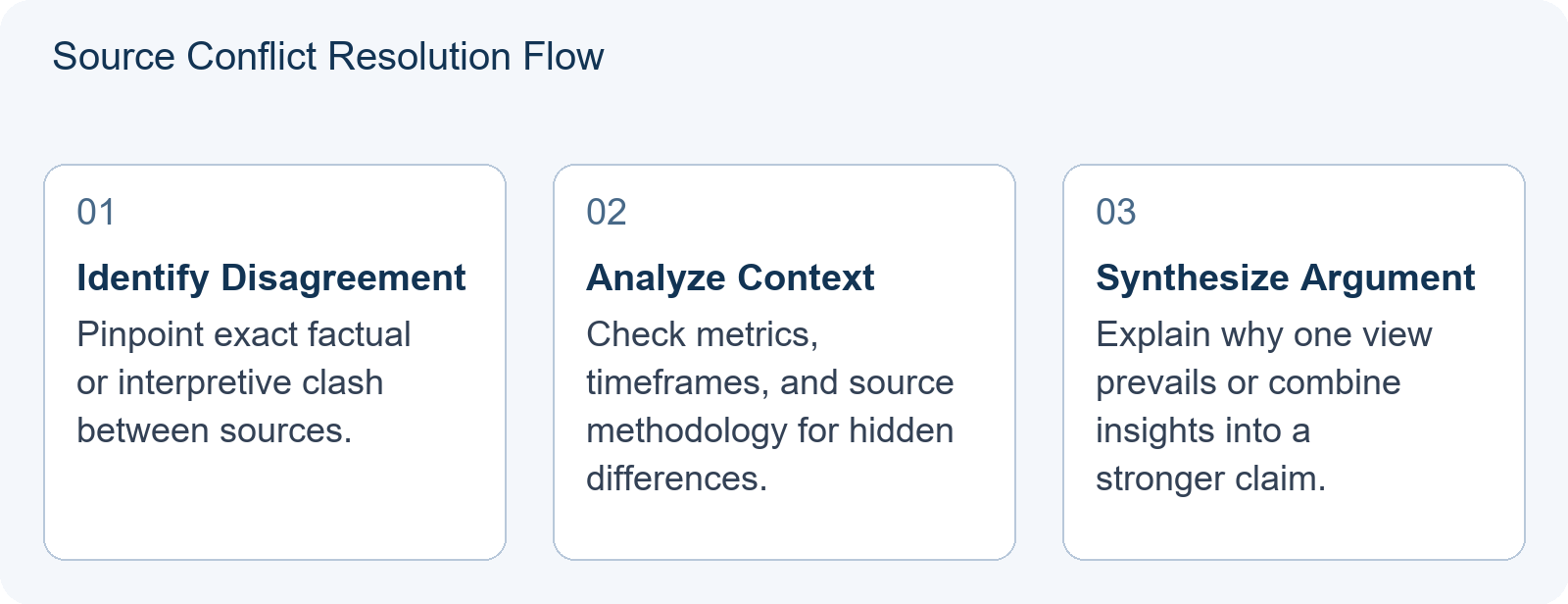
Consider a hypothetical Senior Division essay on Global Culture in the Digital Era. The student argues that algorithmic curation homogenizes cultural consumption. Source A (a major tech industry white paper) claims algorithms increase diversity by exposing users to niche content. Source B (an academic sociological study) argues they create filter bubbles that reinforce existing biases.
A weak response ignores Source A or dismisses it as “biased corporate propaganda.” A strong response maps the disagreement. The student identifies that Source A measures availability of diverse content, while Source B measures actual user engagement patterns. By clarifying the metric difference, the student can argue that while diversity exists technically, behavioral patterns suggest homogenization. This transforms a contradiction into a nuanced point about the gap between potential and practice. The essay now advances an original claim rather than simply reporting what others have said.
Teaching Illustration 2: The Shortcut Failure
The following case is an original teaching illustration, not an official past-paper question or claimed marking criterion.
In contrast, consider a Junior Division essay on Inventions that Changed How We Live, focusing on electric vehicles. Source C states EV adoption reduces carbon emissions by 50%. Source D states lifecycle emissions are only 20% lower due to battery production. A student might simply average these figures to 35% or choose the more dramatic statistic to support a pre-existing thesis.
This shortcut fails because it ignores context. Source C likely refers to tailpipe emissions during operation, while Source D includes manufacturing and disposal. The mistake is treating disparate metrics as comparable data points. The correct approach is to specify the scope of each claim. The argument should acknowledge that operational benefits are substantial, but lifecycle impacts remain significant, leading to a conclusion about the need for circular economy policies rather than simply praising adoption rates. This level of precision distinguishes analytical essays from promotional pieces.
Diagnostic Table: Handling Conflicting Sources
| Scenario | Weak Response | Strong Response |
|---|---|---|
| Different Metrics | Picks one source arbitrarily. | Explains why metrics differ and which is relevant to the prompt. |
| Different Timeframes | Treats current vs. projected data as equal. | Contextualizes short-term vs. long-term effects. |
| Ideological Bias | Dismisses source entirely. | Acknowledges bias but evaluates evidence quality independently. |
| Data Gaps | Fills gaps with speculation. | Notes uncertainty and limits conclusions accordingly. |
Practice Sequence for Preparation
To build this skill before the January 2, 2027 submission deadline, follow this targeted sequence:
- Select a contested topic: Choose a sub-issue within your assigned theme where public debate is active (e.g., AI regulation within Technology, Innovation, and Power).
- Gather three credible sources: Include at least one institutional report, one academic article, and one journalistic piece.
- Identify the core disagreement: Do they disagree on facts, interpretation, or values? Write one sentence stating this clearly.
- Draft a synthesis paragraph: Write 100 words explaining how you will reconcile or prioritize these views in your argument. Test whether your thesis still holds.
This exercise prepares you for the Defense Day oral component, where judges may ask why you chose one perspective over another. Students seeking to improve after previous attempts can consult HIR Essay Feedback: What to Improve After a Bronze or Silver Result for targeted revision strategies. Those using historical comparisons to strengthen their evidence may also find value in Historical Analogies in an HIR Essay: A Four-Test Method for Using the Past as Evidence (2026-27).
Demonstrating Skill Next
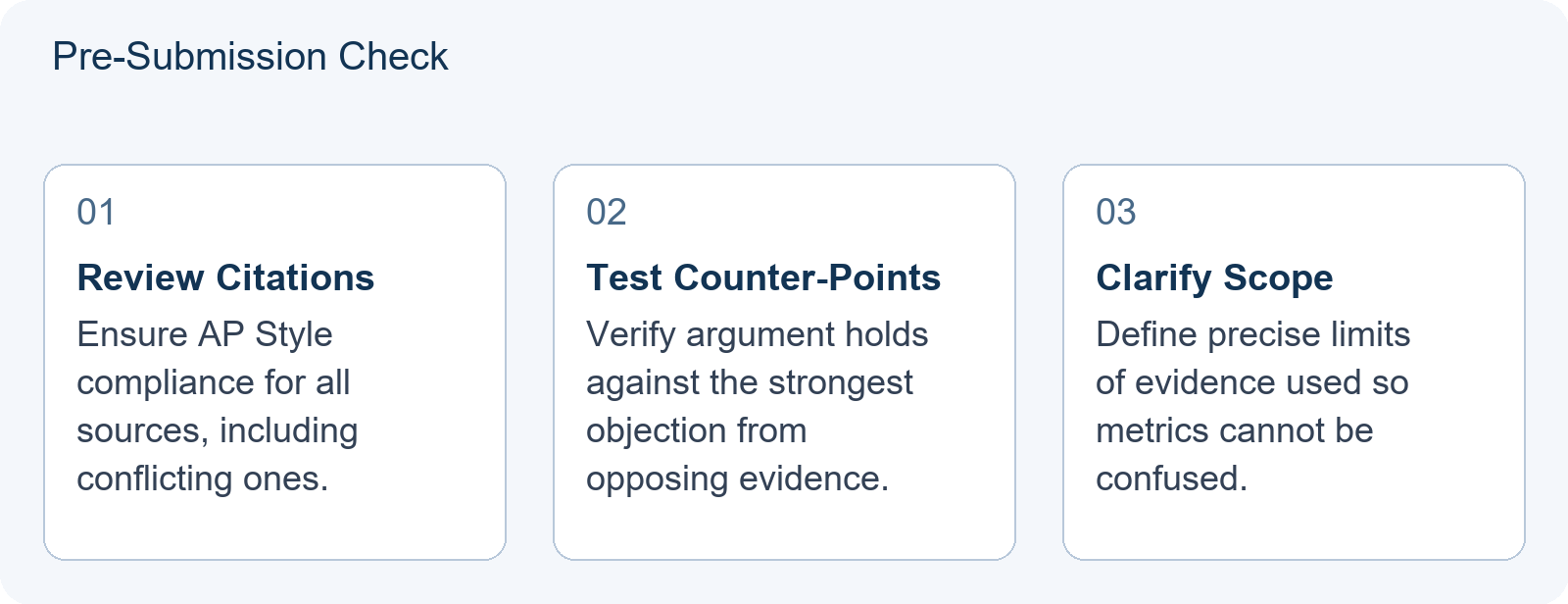
After mastering source mapping, learners should be able to demonstrate critical thinking by explicitly stating the limitations of their chosen evidence. In the final essay, include a sentence acknowledging counter-evidence and explaining why your primary argument remains valid despite it. This shows intellectual honesty and depth, key criteria for Gold Medal consideration in the HIR contest. Remember that HIR uses AP Style; ensure all conflicting sources are properly attributed with consistent formatting throughout your citations.
Frequently Asked Questions
Should I avoid sources that contradict my thesis?
No. Addressing contradictions strengthens credibility. Explain why your thesis remains valid despite opposing evidence, or modify your claim to accommodate the complexity.
How many conflicting sources are too many?
In an 800-1200 word essay, limit deep analysis to one or two major conflicts to maintain clarity and focus. Surface additional disagreements briefly in footnotes if needed.
Does HIR penalize for citing biased sources?
Not if you acknowledge the bias and evaluate the underlying data objectively. Transparency about source limitations is valued more than pretending neutrality exists.