Disclaimer: This is an independent preparation guide produced by HAWC. It is not affiliated with, endorsed by, or officially connected to Harvard International Review or Harvard University.
For China-based families tracking HIR Fall-Winter registration, the gap between the October 25 China region registration deadline and the January 2 essay submission date can cause confusion. These are distinct gates: one determines if you can enter the cycle, the other determines if your work is judged. Mistaking them leads to either unnecessary panic over drafts before October 25 or missed opportunities by delaying registration past the cutoff. This guide clarifies the timeline and helps you plan effectively for both stages.
What HIR is, and why the Fall-Winter registration gate matters
The Harvard International Review was founded in 1979, and the academic writing contest for middle and high school students began in 2020. As of Spring 2026, the source notes describe two contest divisions: Junior Division for grades 7-8 and Senior Division for grades 9-12. The Fall-Winter cycle is one of the contest windows. For China-based entrants, it has a specific administrative cutoff: registration in the China region closes on October 25, 2026, while the essay submission deadline is January 2, 2027. That split is why a single search for the HIR deadline can produce confusing advice.
The source note also lists awards: Gold Medal for the global top 3%, Silver Medal for the global top 10%, Bronze Medal for the global top 20%, plus High Commendation, Outstanding Writing Content/Style, and Commendation honors. Those awards do not change the registration math. They follow article review and, for finalists, Defense Day. The first practical question is still whether the student will be registered before the China cutoff.
Why October 25 and January 2 are different decisions
October 25 is an entry decision. It forces a family to choose a division, confirm grade eligibility, review the published themes, and decide whether the student can realistically research and write an 800-1,200 word English article over the following weeks. January 2 is a submission decision. It tests the quality of the research, argument, sourcing, and AP Style compliance after registration is already secured.
If you are comparing HIR cycles more broadly, the strategic comparison is covered in HIR Registration Timing: Choosing Between Summer, Fall, and Winter Cycles for Your Schedule. This article answers a narrower current-cycle question: how a China-based entrant should separate the October 25 registration cutoff from the January 2 essay deadline.
The source-confirmed Fall-Winter calendar for China-based entrants
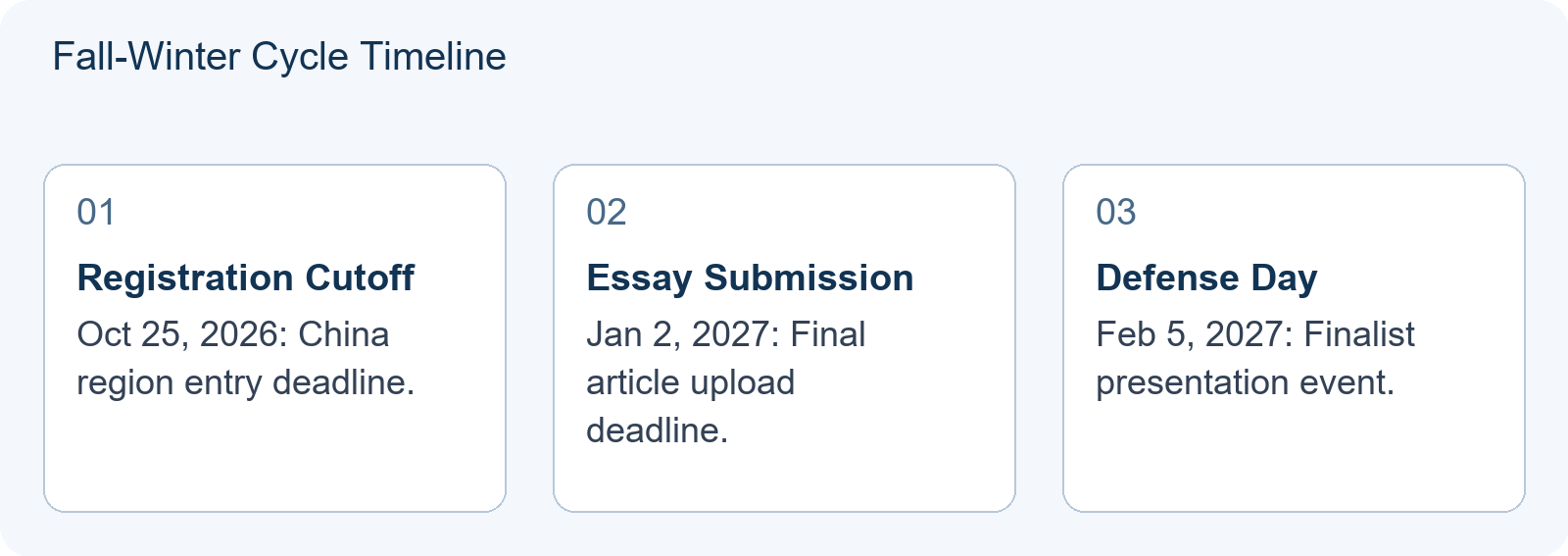
A Hanlin Curriculum note published September 29, 2026 states that the 2026 HIR Fall/Winter Cycle is open, that Junior and Senior prompts have been published, and that the China region registration deadline is October 25, 2026. The same note lists the essay submission deadline as January 2, 2027, and HIR Defense Day as February 5, 2027. A separate Hanlin note published August 10, 2026 also lists the Fall/Winter essay deadline as January 2, 2027, and Defense Day as February 5, 2027.
Those dates give a clean sequence: register by October 25, write and submit by January 2, and, if selected as a finalist, prepare for Defense Day on February 5. The interval from October 25 to January 2 is 69 days, or roughly ten weeks. That is enough time for a serious essay, but only if the entry decision is made before the registration gate closes.
The source notes do not describe a China-region late registration window, a grace period, or an extension. They also do not describe a path for submitting an essay without registration. Treat the October 25 date as the controlling registration date for the China region. If your family cannot meet it, the source-supported alternatives are to plan for a later cycle rather than assume a workaround.
What registration controls, and what the source does not say
In the source’s sequence, registration is the step that puts a student into the Fall-Winter cycle. The essay submission deadline applies to registered entrants. The note does not detail the registration portal, payment flow, confirmation documents, or account troubleshooting. That omission matters: do not build a plan around unstated portal behavior. Follow the current instructions available when you register.
For a related explanation of why competition entry can involve more than one action, see HAWC Registration Explained: Why Entry Is Two Steps, Not One (2026 Summer Cycle). That article is cycle-specific to the 2026 Summer Cycle, so use it as a comparison, not as proof of Fall-Winter rules. The Fall-Winter source notes are the relevant evidence for this cycle’s dates.
Decision fork: enter the current cycle or plan for later
Before October 25, the practical choice is binary: commit to the current Fall-Winter cycle or defer. The source notes do not offer a middle option for China-based families after the registration deadline. A student who is undecided should not register merely to keep options open unless the family is prepared for the January 2 workload. Registration is not a draft deadline, but it is also not a placeholder.
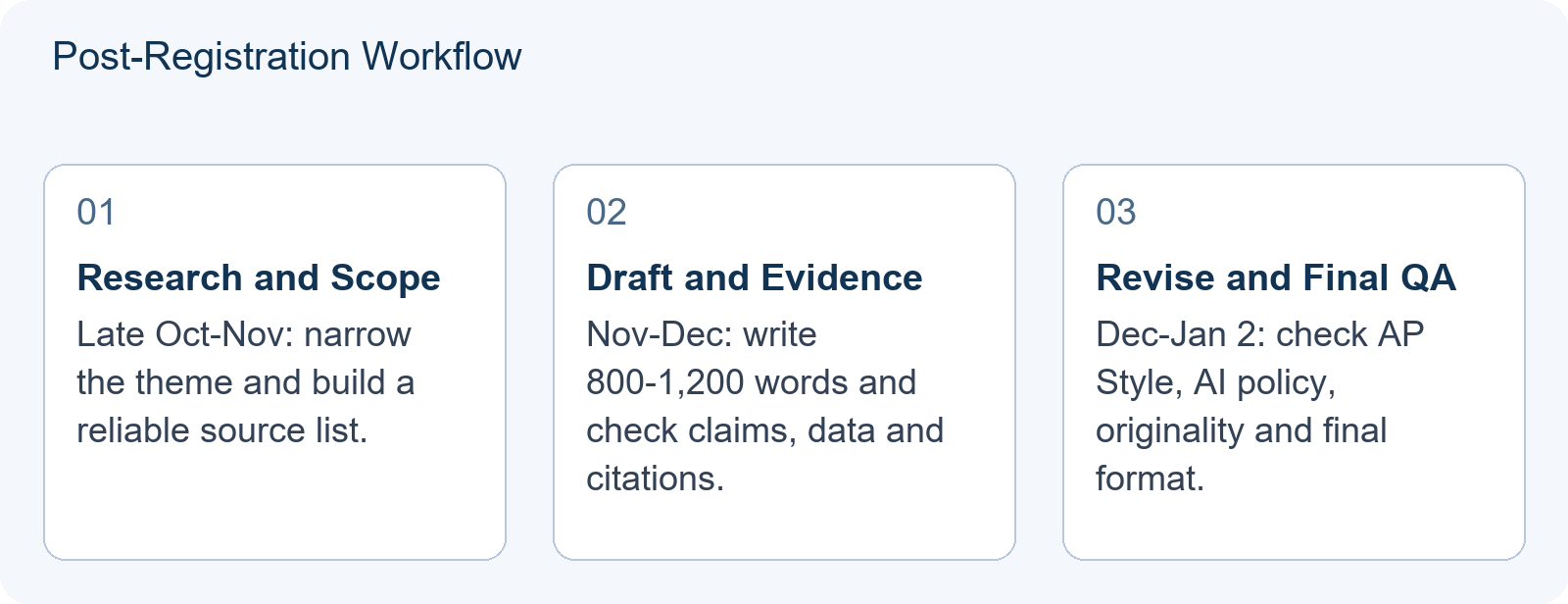
If you choose the current cycle, confirm that the student can produce an 800-1,200 word English article while school term is active. The source’s suggested preparation rhythm places research in late September through October, drafting in October through November, revision in November through December, and final submission work in December through January 2. After October 25, the usable version of that rhythm is late October through November for research, November through December for drafting and evidence checks, and December through January 2 for revision and final quality assurance.
If you defer, do not invent a next-cycle date. The source notes only give the current Fall-Winter dates. A later-cycle plan should wait for a new source note or official confirmation.
Junior vs. Senior and theme choice before registration
The source divides the contest by grade. Junior Division is for grades 7-8 and uses the theme ‘Inventions that Changed How We Live.’ Senior Division is for grades 9-12 and offers three themes: ‘Global Culture in the Digital Era,’ ‘Security in a Multipolar World,’ and ‘Technology, Innovation, and Power.’ Both divisions require an 800-1,200 word English article. A separate Hanlin note states that the word count excludes diagrams, data tables, and the author declaration.
The source does not describe a division-change process after registration. That makes the pre-registration period the right time to decide. Read the theme language, check the student’s grade, and consider what sources are accessible in English and Chinese. A Senior writer choosing ‘Technology, Innovation, and Power’ should not plan to write about technology in general. The 800-1,200 word limit demands a narrow question and a defensible answer. A Junior writer choosing the inventions theme should not simply narrate an invention’s history; the stronger path is to explain how that invention changed a specific part of daily life, work, communication, or public health.
A post-registration writing plan from late October to January 2
Once registration is complete, the essay becomes the priority. The source note’s phased suggestion is a useful starting point. Because the registration cutoff is October 25, not September, a China-based entrant should compress the early phases without skipping them.
Late October through November: research and scope. This is the time to move from a broad theme to a specific question. Build a source list with official documents, think-tank reports, major news outlets, and data from institutions such as the World Bank, IMF, or UN bodies when relevant. The source notes recommend reliable sources and warn against relying on Wikipedia, Zhihu, or Xiaohongshu as main evidence.
November through December: draft and evidence. Write the first complete version early enough to see the argument as a whole. Check that every key factual claim has a source, that data has a denominator where needed, and that the article is not a fact tour. The 800-1,200 word limit means every paragraph must serve the thesis.
December through January 2: revise, check AP Style, and finalize. The source notes state that HIR uses AP Style and that students should not import MLA or APA conventions by habit. Check names, institutions, countries, numbers, titles, and quotation attribution. Keep spelling consistent with American English where the contest expects it. Also verify the AI policy. A separate Hanlin note states that HIR prohibits ChatGPT and similar AI tools and that entries with high AI-generation scores across multiple detectors can be disqualified. Original student research, analysis, and writing are therefore part of submission compliance, not an afterthought.
Teaching illustration only, not an official HIR prompt: for the Senior theme ‘Technology, Innovation, and Power,’ a workable narrowing might be ‘How did one named export-control measure affect a specific semiconductor supply chain?’ That is not a contest prompt. It simply shows the level of specificity the 800-1,200 word limit usually requires.
For a schedule that treats January 2 as the fixed endpoint, see The 2 January Deadline Lands in Your Busiest Term: A Fall-Winter HAWC Schedule Built Around Applications and Mocks. It is useful after the registration decision, when the question changes from whether to enter to how to finish.
Common mistakes: October 25 as draft deadline, January 2 as registration deadline
The first mistake is believing a finished essay is due October 25. It is not. October 25 is the China region registration deadline. A draft is not required to register, though a realistic plan is.
The second mistake is assuming that because the essay is due January 2, registration can wait until December. The source notes do not support that assumption for the China region. The registration cutoff is October 25, 2026.
The third mistake is treating the two dates as one long deadline. They are separated by 69 days. That gap is the writing runway, but it only exists for students who are already registered.
The fourth mistake is ignoring source, style, and AI compliance until the final week. AP Style, citation reliability, and originality requirements affect whether the submitted article is eligible and competitive. They should be checked during drafting, not discovered on January 1.
Practical registration checklist before October 25
- Confirm whether the student belongs in Junior Division (grades 7-8) or Senior Division (grades 9-12).
- Choose the Junior theme or one Senior theme before registering, because the source notes do not describe a later division-change process.
- Mark both dates separately: October 25, 2026 for China region registration; January 2, 2027 for essay submission.
- Plan the 800-1,200 word article around a narrow question, not a broad topic.
- Set aside research time in late October and November, drafting time in November and December, and revision time in December through January 2.
- Review AP Style and the current AI policy before drafting, then recheck before submission.
- If you are undecided, decide before October 25. The source notes do not provide a late-registration safety net for the China region.
What this means for China-based families
The October 25 date is not a scare tactic, and January 2 is not permission to delay registration. They are administrative and creative deadlines for different stages. A family that understands the difference can make a clear choice: enter the current HIR Fall-Winter cycle with enough time to write a serious essay, or wait for a later cycle without pretending that a missed China registration deadline can be repaired in January.
If the student is ready, the next action is simple: confirm the division and theme, complete registration by October 25, then begin research immediately. The essay deadline will arrive faster than a ten-week runway suggests.
Frequently Asked Questions
Can I register for the HIR Fall-Winter cycle after October 25?
The source notes state that the China region registration deadline is October 25, 2026. They do not describe late registration or an extension for this cycle.
Do I need to finish my essay by October 25?
No. October 25 is the China region registration deadline. The essay submission deadline is January 2, 2027, giving registered students roughly ten weeks to research, draft and revise.
Is there a difference between Junior and Senior registration?
Yes. Junior Division is for grades 7-8 and uses the ‘Inventions that Changed How We Live’ theme. Senior Division is for grades 9-12 and offers three themes. The source notes do not describe a division-change process after registration, so choose before October 25.