Direct answer: calibrate before you revise
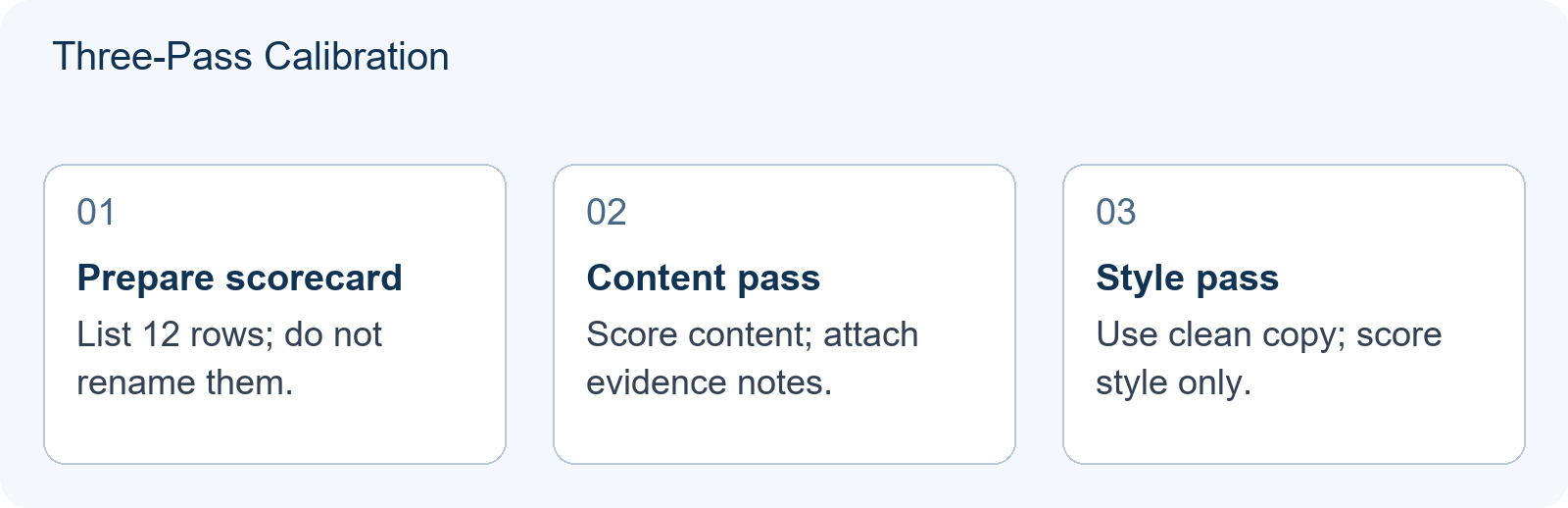
HIR rubric calibration is the step between knowing that a rubric exists and knowing what to change in one draft. For the 2026-27 Fall-Winter cycle, whose essay submission deadline is 2 January 2027, the useful method is not to reread the essay and assign twelve general impressions. It is to score in three separated passes: content rows without editing, style rows on a clean copy, then a reconciliation pass that accepts a score only when a draft sentence or a missing element supports it. The verified 60-point frame used here is 12 rows scored 1-5, with Content 30 plus Style 30. Self-scoring is a revision aid, not a prediction of awards, medals, or Finalist status.
This guide is independent and is not affiliated with or endorsed by the Harvard International Review or Harvard University. It describes a preparation perspective, not an official scoring procedure. The three-pass clinic below is a teaching method; the rubric frame and style requirements are the fixed frame.
What the verified rubric lets you score, and what it does not
The 60-point frame used in this guide is the verified rubric frame: 12 rows scored 1-5, with Content 30 plus Style 30. Hanlin Courses’ 29 September 2026 WeChat report, 2026 HIR Harvard International Review Summer Cycle Results Released! Next Fall-Winter Cycle… (translated from Chinese), notes that HIR uses AP Style and advises checking spelling consistency, title case, number style, and reliable source attribution before submission. The verified style frame used below also includes spelling out percent, using the Oxford comma, avoiding footnotes, using hyperlinked citations, and keeping the essay to 800-1,200 words excluding figures.
Those facts let you build a scorecard. They do not let you rename official rows from memory, merge two rows because they feel similar, or invent a row that the current rubric does not contain. If the current rubric is not in front of you, stop and retrieve it. Write the row labels exactly as they appear, or use neutral placeholders and mark them as placeholders. A score without a named row and a draft evidence note is only a mood.
The arithmetic is simple but easy to misuse. Twelve rows at 5 points total 60. Twelve rows at 3 points total 36. That second number does not mean the draft is ‘almost there’; it means 24 points are unearned, and some of those points may be expensive to pursue. A row at 2 has 3 points available, but recovering them may require a new source, a narrower claim, or a counterargument. A row at 4 has 1 point available, but the fix may be a quick formatting repair. Calibration tells you which case you are in.
Prepare the scorecard before reading
Make a blank sheet with exactly 12 rows. Keep the two 30-point halves separate: Content on one side, Style on the other. Do not pre-fill 3s to seem balanced. Do not combine rows to reduce the number of judgments. For each row, create two columns: score and evidence note. The evidence note must point to a sentence, a missing element, or a pattern you can show another reader. If you cannot describe what a 2, 3, 4, or 5 looks like for that row, you are not ready to score it; reread the rubric first.
Before Pass 1, write one sentence at the top of the sheet: ‘I am scoring this draft as it is, not as I intend to revise it.’ That sentence matters because a common calibration failure is to score an imagined improved version. The writer sees the claim they meant to make, the source they planned to add, and the counterargument they discussed aloud. The rubric can only score what is on the page.
Pass 1: content without editing
Read for the content half only. In a practical content pass, ask whether the draft answers the prompt, supports its claims with reliable evidence, analyses rather than merely reports, and confronts at least one serious objection. Those are teaching questions, not a substitute for the current row labels. For every content row, write one line that begins: ‘Score because…’ A line such as ‘feels thin’ is not evidence. A line such as ‘Claim appears in paragraph 2; no linked source for the fee estimate; objection mentioned but not answered’ is evidence.
Do not edit during Pass 1. Do not fix a citation, tighten a transition, or rewrite a topic sentence. The moment you edit, you begin scoring the revised draft and lose the baseline. If a content problem affects many rows, note it once and keep scoring. For example, a missing counterargument may weaken several content judgments, but you still need to decide whether each row is affected and by how much.
Pass 2: style on a clean copy
Print or open a clean copy. Do not reread the argument for content quality. Score the style half against the verified requirements: percent spelled out, the Oxford comma, no footnotes, hyperlinked citations, and 800-1,200 words excluding figures. Apply the AP Style checks named in the Hanlin report: spelling consistency, title case, number style, and reliable source attribution. A sentence such as ‘shops, clinics, and transport operators’ shows the Oxford comma; ‘forty percent’ shows the percent rule; a missing hyperlink is a style defect even when the underlying source is good.
For the word-count requirement, use the HIR Essay Word Count Audit: Cutting an Over-Limit Draft Without Losing Rubric Points (2026-27) method rather than guessing from page count. For coherence and transitions, the related discussion of Ten of the 60 Points Are in the Joins: Transitions and Coherence in an HIR Essay is the relevant adjacent guide. Neither link replaces the current rubric; they help you apply a row consistently. Keep style notes separate from content notes. A style score should not rise because you admire the argument, and a content score should not fall because a comma is missing.
Pass 3: reconcile with evidence
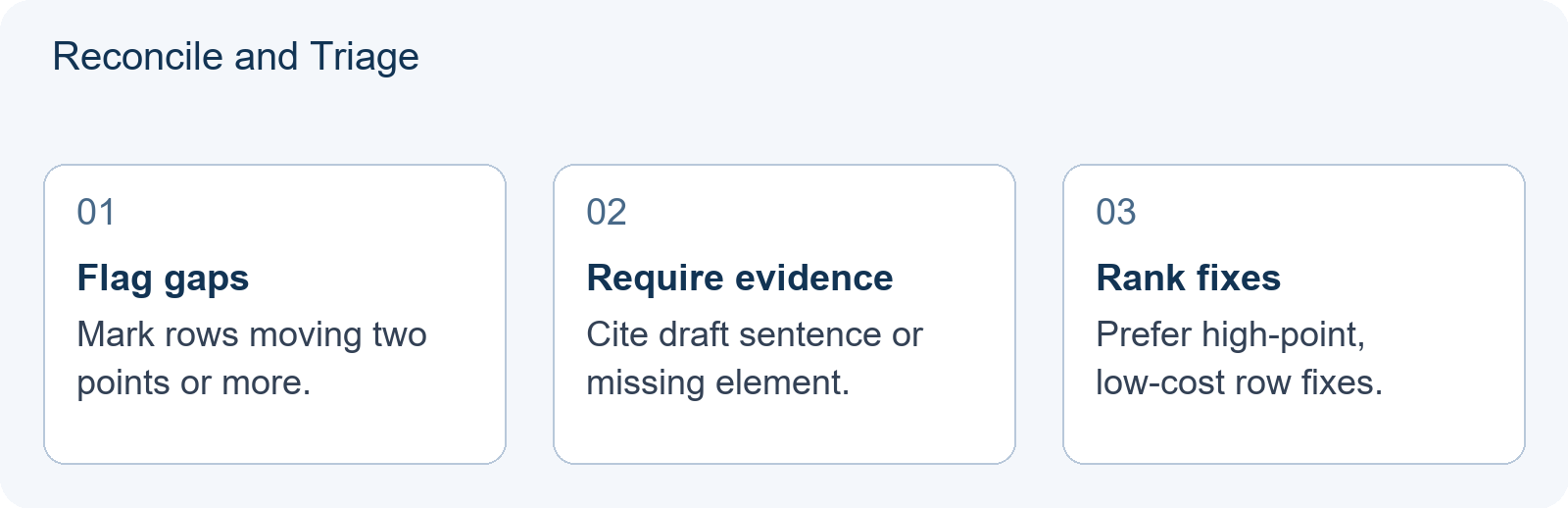
Before Pass 1, record an initial row-level impression for each row. Then compare that initial impression with the later pass score. Flag any row where the initial impression and the pass score differ by two points or more. A gap is not automatically an error. It is a request for evidence. If you cannot point to a draft sentence or a missing element, the row score should move toward the evidence, not toward your confidence.
| Row | Initial row impression | Pass score | Gap | Draft evidence | Decision |
|---|---|---|---|---|---|
| Content placeholder row, not an official label | 4 | 2 | 2 | Clear claim; no linked source for the central factual claim; objection absent | Investigate first |
| Style placeholder row, not an official label | 3 | 3 | 0 | Oxford comma present; one citation lacks a hyperlink | Minor fix |
The content-row gap is the one to investigate because a two-point gap can hide a halo effect: the draft sounds authoritative, so the reader remembers it as better evidenced than it is. The style-row gap is zero, but the row still has a low-cost repair. Reconciliation is not about making all rows agree. It is about making every score defensible.
Teaching illustration: two hypothetical paragraphs
Teaching illustration only; this is not an HIR prompt, sample, or scored contest entry. Imagine a draft paragraph: ‘Public instant-payment systems should be free for small vendors because fees fall hardest on low-volume shops. When a shop pays a fixed charge on every transfer, the owner may refuse small digital payments, which pushes customers back to cash. Making the service free would widen participation and reduce the cost of doing business.’ For a content placeholder row, a writer might give 2 out of 5. There is a claim and a mechanism, but no linked evidence for the fee claim, no defined scope for ‘small vendor’, and no answer to the objection that free systems still carry infrastructure costs. The gap between an initial row impression of 4 and a pass score of 2 is exactly the kind of discrepancy reconciliation should expose. The revision is not ‘write more’; it is ‘source the fee claim, define the vendor category, and answer one cost objection.’
Imagine a style paragraph: ‘The system is used by shops, clinics, and transport operators. The pilot reached forty percent of registered users.’ In this teaching illustration, the Oxford comma appears and percent is spelled out. If the second sentence has no hyperlinked source, a style placeholder row might be 3 out of 5 even though the prose is readable. The fix is small and local: add the hyperlink or revise the sentence so the claim is clearly attributed. The hypothetical figure is illustrative only; it is not a real statistic and should never be reused as evidence.
Revision triage: points available versus revision cost
After reconciliation, rank rows by points available and revision cost. Points available is 5 minus the row score. Revision cost is your judgment about whether the fix is local, sectional, or whole-essay. A row at 2 with a missing source may be medium cost. A row at 3 with an uncited quotation may be low cost. A row at 4 with a title-case error is very low cost. Do not spread effort equally across twelve rows.
| Row score | Points available | Typical decision |
|---|---|---|
| 2 | 3 | Fix first if the missing evidence or claim can be repaired without changing the whole argument |
| 3 | 2 | Fix if a specific source, definition, or objection can be added at row level |
| 4 | 1 | Fix only if the repair is quick and does not disturb a stronger section |
Distinguish a row-level fix from a whole-essay scope problem. If five content rows are low because the draft never defines its central term, adding one definition may help several rows, but it will not automatically earn all available points. If the essay answers a different question from the one asked, no amount of row polishing is calibration; it is rescue. The HIR Essay Feedback Before You Submit: Briefing a Reviewer for Rubric-Specific Comments (2026-27) guide is useful here because it turns a vague request for comments into a row-specific request.
Prepare a rubric-specific review request
If you ask a teacher, tutor, or experienced reader for feedback, bring the completed scorecard, not just the draft. Mark two paragraphs that caused disagreement between your initial row impression and your pass score. Name one row you cannot score confidently and one row where you deliberately disagree with your own first pass. Ask for evidence tied to that row: ‘Which sentence supports a 4 rather than a 3?’ or ‘What is missing for this row to reach the next level?’ A reviewer can then respond with specifics instead of general praise or general worry.
This preparation also helps a review conversation start from specifics. A useful review conversation should be able to distinguish a formatting repair from an argument repair, and a row-level gap from a scope problem. If the conversation stays at the level of ‘make it stronger’, the scorecard has not done its job. Bring the evidence notes and ask the reviewer to challenge them. The goal is not to collect a second set of scores; it is to leave with a defensible revision order.
Calibration will not make self-scoring objective. It will make it slower in the right places and faster in the wrong ones. Before the 2 January 2027 deadline, the practical gain is a revision plan that can explain why a row moved, why another row was left alone, and which missing element is worth the next hour.
General event background is available at Event background.
Frequently Asked Questions
Do HIR self-scores predict awards?
No. A calibrated self-score is a revision tool. It can show which rows have evidence gaps, but it cannot predict medals, Finalist status, or how other entries will be judged.
Must every rubric row change before submission?
No. Some rows may already be defensible. Revise the rows where you can point to a missing element or a weak draft sentence, and leave rows alone when the evidence supports the current score.
How should I brief a reviewer with a completed scorecard?
Bring the 12-row scorecard, two flagged paragraphs, one row you cannot score, and one disagreement with your own first pass. Ask for row-specific evidence rather than a general impression.