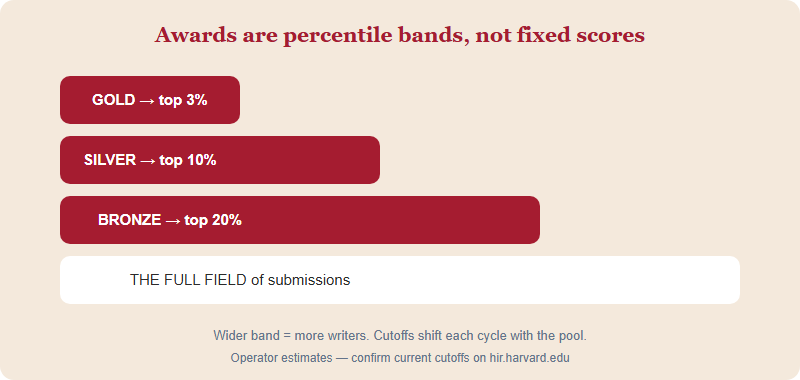
HAWC recognizes standout essays in three tiers — Gold, Silver, and Bronze — awarded by percentile rather than a fixed score. Per operator guidance the bands are roughly the top 3 percent, top 10 percent, and top 20 percent of the field; confirm current cutoffs on hir.harvard.edu. Here is what each tier actually means, how selective it is, and how to read the signal honestly — without the hype that surrounds essay-contest awards.
The Three Tiers, by Percentile
The most important thing to understand is that HAWC awards are percentile-based, not score-based. You are not clearing a fixed bar; you are placing within the field of submissions for that cycle. That has real consequences for how you should think about your odds and your result.
| Tier | Approx. band (operator note) | What it reflects |
|---|---|---|
| Gold | ~ top 3% of the field | Among the strongest analytical essays in the cycle |
| Silver | ~ top 10% of the field | Clearly above the large middle of submissions |
| Bronze | ~ top 20% of the field | Recognized work — still the top fifth of a global pool |
| Recognized / participant | remainder | A completed, submitted analytical essay |
Because the bands are percentiles, the effective difficulty moves with the applicant pool: a stronger, larger field makes each tier harder to reach, and vice versa. Treat these percentages as operator guidance and confirm the current-year cutoffs and exact tier names on hir.harvard.edu — HAWC is an independent contest run by the Harvard International Review and may adjust recognition each cycle. New to the contest? Our overview of what the HIR Academic Writing Contest is explains where awards sit in the process.
It also helps to know what the tiers do not measure. They are not a comment on effort, on how much a student cares, or on whether a topic is worthy — only on how the finished essay compared with others this cycle. Keeping that boundary clear lets a family celebrate a strong result without over-reading it, and absorb a quiet result without letting it define a capable young writer.
What a Percentile Award Actually Tells You
A percentile award is a statement about relative standing in one cycle — not a permanent grade on your ability. That framing keeps you honest in both directions. On the encouraging side, a Bronze is not a consolation prize: being in roughly the top 20 percent of a self-selected, international field of analytical writers is a genuine result. On the sober side, a Gold in a smaller cycle and a Gold in a larger, stronger cycle are not identical achievements, even though the medal name is the same.
This is why chasing a specific tier is the wrong mental model. You cannot control the field; you can only control the quality and defensibility of your own essay. Writers who fixate on “getting Gold” tend to inflate their claims and over-reach. Writers who fixate on making one argument airtight tend to place well as a byproduct.
Percentile framing also protects your motivation. If you submit a genuinely strong essay and land outside the tiers in a fierce cycle, that is information about the field, not a referendum on your ability — the same essay might have placed in a different year. Conversely, an award earned in a thin cycle is real but worth holding lightly. The healthiest stance is to judge your own work against the rubric's standards, treat the tier as external weather, and keep improving regardless of where you land this time.
The Admissions Signal — Without the Hype
Families ask the honest question: does a HAWC award help with university admissions? The honest answer is that it can be a credible data point in a portfolio — and it is not a guarantee of anything. We make no admissions promises, and results vary widely by student, school, and target program. What a recognized HAWC essay can signal:
- Analytical writing ability tested against an external, international standard rather than a class grade.
- Initiative — a student who sought out a rigorous contest and finished it.
- Ownership of ideas — especially where a live Defense Day round is involved, an award reflects a student who could stand behind their argument.
What it is not: a ticket that “gets you in,” a substitute for grades and coursework, or something worth misrepresenting. Admissions readers value a coherent story more than a stack of medals; one genuinely-owned analytical essay you can discuss beats three you cannot. Frame any HAWC result as one honest line in a larger portfolio, not the headline.
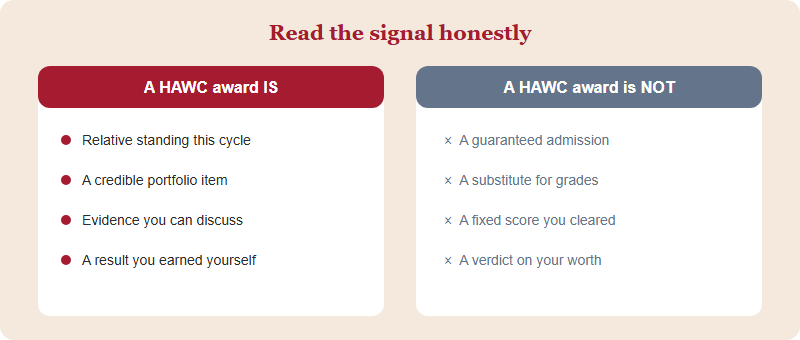
The distinction on the right matters most for families new to essay contests. It is tempting to treat a shiny award as the goal and everything else as a means to it. Flip that. The goal is a piece of analytical writing your student genuinely owns and can discuss; the award, if it comes, is evidence of that ownership. Admissions readers can tell the difference between a student who collected a credential and one who did the thinking — and only the second kind survives a follow-up question about the work.
How to Aim Higher — Process, Not Promises
You cannot buy a tier, and no one can guarantee one. What you can do is pull the levers the judging actually rewards. All of them are within your control:
| Lever | Why it moves your standing |
|---|---|
| A narrow, defensible thesis | Rewarded across the rubric's content dimensions; vague essays stall in the middle |
| Analysis over description (“argument, not agenda”) | The rubric weights analysis of evidence heavily over summary |
| Evidence you can explain | Depth reads as command; it also survives the oral round |
| Clean, human authorship | AI-generated work is barred; your own voice is what earns credit |
| A strong Defense Day | Where finalists demonstrate they truly own the argument |
Two of these deserve a closer look. To see how points are actually distributed, read our decode of the 60-point rubric — it shows why analysis outscores description. And because the oral round can separate similar essays, our Defense Day preparation guide is worth reading before you submit, not after.
Notice what is not on that list of levers: knowing the “right” topic, using bigger words, or padding the bibliography. None of those move a percentile-based result, because judges are comparing how well writers reason, not how impressive their subjects sound. Two writers can pick the same theme and land three tiers apart purely on execution. That is oddly liberating: you do not need a secret topic or an insider trick, only a claim you can defend and the discipline to defend it cleanly.
First-Party Notes: What We Tell China-Based Families
Working with international-school students across China, our editors keep coming back to the same message (patterns are de-identified, and results vary): recognition is a byproduct of genuine analysis, not a target to game. The students who place well are rarely the ones who asked “how do I get Silver?” They are the ones who asked “is my argument actually true, and can I defend it?”
We also gently reset expectations about odds. Because Bronze already means roughly the top fifth of a self-selected international field, a first-time entrant landing in “recognized” rather than a tier has still produced a competitive essay against strong company — and now has a finished piece to revise for the next cycle. Framing results this way keeps students motivated instead of discouraged, which in our experience is the single biggest factor in whether a young writer comes back and improves.
Two practical reminders. First, the finished essay is the asset that survives any single result — a polished, genuinely-yours analytical piece is useful in interviews and applications whether or not it earns a tier this cycle. Second, timing: the 2026 Summer cycle is open now, with operator guidance for the China region pointing to a late-July registration window and a late-August submission window; confirm the exact dates on hir.harvard.edu, as some public listings show an August 31 window and the site runs on official time zones. Aim for a defensible essay, not a medal — and let the tier take care of itself.
FAQ
How are HAWC awards decided?
By percentile within the cycle's field — roughly top 3% Gold, top 10% Silver, top 20% Bronze per operator guidance. Confirm current cutoffs on hir.harvard.edu.
Is a Bronze worth anything?
Yes — it reflects roughly the top fifth of a global, self-selected pool of analytical writers. It is a real result, not a participation note.
Will a HAWC award get me into university?
No award guarantees admission. It can be one credible data point in a portfolio; results vary by student and program.
Can I aim for a specific tier?
You cannot control the field, only your essay. Focus on a defensible argument and a strong defense; standing tends to follow.
This is an independent guide operated by Hanlin Education for China-based international-school students. It is not affiliated with, endorsed by, or sponsored by the Harvard International Review or Harvard University. Award tiers, cutoffs, deadlines, and rules can change — always confirm current details on hir.harvard.edu. We correct errors within 7 working days.