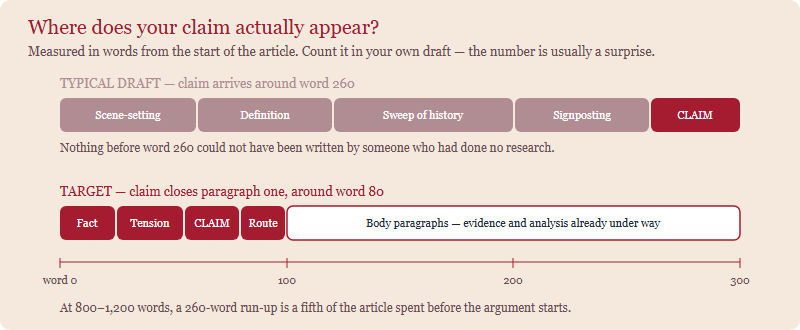
“Introduction” is one of the six Content dimensions on the HIR contest rubric, worth five points in its own right — and it is decided almost entirely in your first 100 words, roughly 8–12% of an 800–1,200 word article. Most students spend that budget on scene-setting and reach their actual claim in paragraph three. This is how to rebuild the opening so the headline and the first paragraph do the work the rubric is asking for.
This is also the cheapest fix available late in a cycle. Rebuilding an argument takes days; rebuilding an opening takes an hour, and it can move a rubric line. If you are working toward the Summer window, note that it closes in late August — confirm the exact date and time on hir.harvard.edu before you plan your final week — and treat the opening as the last substantive change you make before you freeze the text.
What the introduction line is actually scoring
The rubric splits Content into six five-point dimensions: topic, introduction, structure and transitions, use of evidence, analysis of evidence, and overall coherence. Two of those — topic and introduction — are largely settled by the time a judge finishes your first paragraph. Our full reading of the 60-point rubric covers the whole grid; here it is enough to notice what a judge is checking for in the opening.
- Is there a claim, and can I find it? Not a subject. A sentence that could be disagreed with.
- Is the scope handleable in 1,200 words? An opening that promises “the future of global trade” has already failed this test.
- Do I know why this is being written now? Some tension, puzzle or contradiction that makes the question live rather than academic.
- Does the article tell me where it is going? A route, not a table of contents.
Four things, 100 words. That is a genuine constraint, and the reason most openings fail is that they spend the budget on a fifth thing nobody asked for: atmosphere.
The headline is not a title
School essays have titles — nouns, often ornamental. AP-style publications have headlines, which are working sentences. The difference is not decoration: a headline that states the claim tells the judge, before the first word of prose, that this is an argument rather than a survey.
| Headline type | Illustrative example | What it signals | Verdict |
|---|---|---|---|
| Ornamental / literary | “Bridges and Barriers” | Nothing. Could sit on 500 other articles | Delete |
| Topic label | “Semiconductor Supply Chains in Southeast Asia” | A subject, not a position | Weak |
| Question | “Can Regional Trade Blocs Survive?” | Invites a yes/no the article may not deliver | Risky |
| Colon + subtitle | “Chips and Choke Points: How Export Controls Reshaped Regional Assembly” | Subject plus mechanism — workable | Good |
| Claim headline | “Export Controls Shifted Assembly, Not Design — and That Distinction Decides the Policy” | A position a reader could contest | Strongest |
Three drafting notes. Use a live verb: a headline built on “is” or “are” almost always describes rather than argues. Keep it inside about a dozen words, because a headline you cannot say in one breath is a paragraph in disguise. And write it last — if you cannot compress the finished article into a claim headline, that is diagnostic information about the article, not about your headline skills.
The four openings that waste your first 80 words
These four account for the overwhelming majority of weak openings we see in drafts, and each one is recognisable in a single glance.
- The establishing shot. “In the bustling port of Singapore, cranes move ceaselessly against a humid dawn…” Costs 40 words, earns nothing. Journalism uses scene openings with a real reported detail; a scene you have imagined is not reporting, it is decoration.
- The dictionary. “Globalization can be defined as the increasing interconnection of…” A judge who reads global-affairs essays does not need the term defined, and defining it signals you had nothing sharper to open with.
- The march of history. “Since the end of the Second World War, the international order has…” Any article can start here, which is precisely the problem. If your first sentence would fit on a hundred other essays, it is doing no work.
- The rhetorical question. “But what does this mean for the future of the region?” It postpones the claim and puts the burden on the reader. Answer it instead, in the declarative.
The common structure underneath all four is delay: the writer warms up in public. Professional openings do the warming up in a draft nobody reads and then delete it. A useful rule when you revise: find the first sentence in your article that only you could have written, and start there. Everything above it is throat-clearing.
A 100-word architecture that works
Here is a budget you can actually hold to. It is four moves, and the proportions matter more than the exact counts.
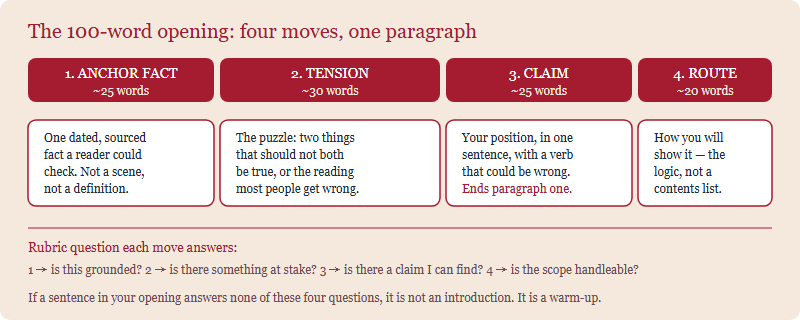
A note on move 2, because it is the one that separates a competent opening from a memorable one. Tension is not urgency. “This issue is more important than ever” is urgency, and it is empty. Tension is a specific contradiction: a policy that produced the opposite of its stated aim, two credible sources that disagree, a trend that reversed when everyone expected it to continue. If you cannot name the tension, you have a topic rather than an argument — and no opening rescues that. That is a scoping problem, addressed before you write.
A worked rebuild
Same student, same research, same evidence. Only the first paragraph changes. Both versions below are constructed for illustration.
| Weak opening (about 95 words) | Rebuilt opening (about 95 words) | |
|---|---|---|
| Move 1 | “Water has always been essential to human civilisation. Across history, rivers have shaped where people settle…” | “A river-basin agreement signed in the 1990s still governs how four states share a shrinking flow — and its allocations were set using rainfall data from a wetter decade.” |
| Move 2 | “Today, water scarcity is becoming an increasingly urgent global issue affecting billions of people.” | “Every party still calls the treaty a success. Every party is also quietly building storage upstream, which the treaty does not forbid and did not anticipate.” |
| Move 3 | “This essay will examine the causes and consequences of transboundary water disputes.” | “The agreement is not failing because states are cheating. It is failing because it fixed shares rather than a method for revising them.” |
| Move 4 | “First it will look at history, then at politics, then at possible solutions.” | “Comparing its drought clause with two later basin agreements shows what a revision mechanism does that a fixed share cannot.” |
| Judge's read | Topic identified. No claim. Scope unbounded. Route is a contents list. | Claim is falsifiable, scope is one clause in one treaty, route is a comparison with a stated purpose. |
Notice what the rebuilt version does not do. It does not announce itself (“this essay will…”), does not define anything, and never uses the word “important.” It also commits: a reader who thinks the treaty is failing because of cheating now has something to disagree with, which is exactly what makes the article defensible later. That link matters if you are selected — a 15-minute oral defense is much easier when the thing you are defending was stated in one sentence on page one, as our Defense Day preparation guide sets out.
The 10-minute opening audit
Do this on a printed first page, before the final style pass.
- Cover test. Cover everything except your first paragraph and hand it to someone outside your subject. Ask them to write down, in one sentence, what you are arguing. If they write the topic instead of the claim, move 3 is missing or buried.
- Delete-the-first-sentence test. Cut sentence one and reread. If the paragraph is unharmed — or better — the sentence was throat-clearing. Repeat until deletion hurts.
- Verb test. Underline the main verb in your claim sentence. If it is “is,” “are,” “has” or “remains,” you have described a state of affairs. Rewrite with a verb that asserts a mechanism: shifted, forced, masked, transferred, foreclosed.
- Headline match. Read your headline, then your claim sentence. If they are not saying the same thing, one of them is lying about the article.
- Specificity count. Count the proper nouns, dates and figures in the first 100 words. Zero is a failing opening. Two or three is usually right; more than five and you have written a data dump instead of an argument.
Two practical constraints to keep in view while you do this. Your opening sits inside the 800–1,200 word limit like everything else, so a 160-word introduction is 13–20% of your budget spent before the argument starts. And the opening is written in AP Style like the rest — numbers, dates and titles all follow the house conventions, and an introduction with a British-format date is the first thing a style reader sees. If the contest structure itself is still unfamiliar, our foundation guide to the contest sets out divisions, cycles and judging in one place.
Questions students actually ask
Where exactly should the thesis sentence go?
At the end of the first paragraph, after the anchor fact and the tension. Judges look for a findable claim early; burying it in paragraph three costs you the introduction line.
Can I open with a question?
Better not to. A rhetorical question postpones your claim and shifts work to the reader. Answer it in the declarative and you have a thesis instead.
Does the headline count toward the word limit?
Treat it as if it might and keep it short regardless. Confirm what the organiser counts on hir.harvard.edu rather than guessing.
Should I write the headline first or last?
Last. If you cannot compress the finished article into one claim headline, the problem is the article's focus, not your headline writing.
This is an independent guide operated by Hanlin Education for China-based international-school students. We are not affiliated with, endorsed by, or sponsored by the Harvard International Review or Harvard University. All example headlines and openings in this article are constructed for illustration and are not drawn from submitted entries. Rubric wording, word limits, cycle dates and style requirements are set by the organiser and can change — confirm current details on hir.harvard.edu before you rely on anything here. Errors reported to our editorial desk are corrected within 7 working days.