The HIR contest states its position on AI plainly and requires an authorship declaration. On what a teacher, tutor or parent may do, the public contest page says considerably less. That silence is not permission. The practical test is Defense Day, where judges assess the authenticity of the work in person — so the working rule is simple: if you cannot defend a sentence, it is not yours.
What the rules say, and where they are quiet
Start with what is actually written down, because a surprising number of students and parents are operating on assumptions borrowed from other competitions.
| Area | What the contest page states | What it means in practice |
|---|---|---|
| AI tools | “The usage of ChatGPT and other AI tools and software is strictly prohibited. Judges will be running all articles through multiple AI checkers, and articles that receive high AI generation scores across multiple checkers will be disqualified” (hir.harvard.edu) | Not a discouragement — a disqualification rule with a stated screening method. Anything borderline should be confirmed with the organisers, not guessed at |
| Authorship declaration | Required with the submission, and excluded from the 800–1,200 word count | You sign something about the origin of the work. Read the wording in the Submission Guide before you sign, not after |
| Individual entry | The materials treat the entry as single-author; the public page does not spell this out — see the Submission Guide | There is no co-author line. Whatever help you had, one name carries the essay |
| Defense Day | A 15-minute presentation and oral defense before HIR judges; materials describe judges assessing “authenticity of work” during the interview stage | The check on authorship is not only a software scan. It is a person asking you why paragraph three exists |
| Human feedback | The public contest page we can see does not set out a rule on teachers, tutors, parents or editors | Read that as unresolved, not as permission. Check the Submission Guide, and ask the organisers via hir.harvard.edu if your situation is unusual |
That last row is the one worth sitting with. Every school essay you have ever written came with a feedback culture attached — teachers annotate drafts, that is their job, and in an IB or A-Level context there are formal rules about how much of that is allowed. A competition entered from outside school has no such scaffolding, and the absence of a stated rule invites people to invent a generous one. Do not. The honest position is that we do not know where HIR draws the line on human feedback because the page we can read does not say, and the responsible thing is to check the official Submission Guide and, where it matters, ask.
Disclosure: Hanlin Education runs writing coaching, so we have a commercial interest in this question. That is exactly why the line drawn below is conservative. The only version of coaching that survives an oral defense is the version in which the student does the writing.
Defense Day is the authenticity check
Here is the structural fact that makes this contest different from a submit-and-hope essay prize. The strongest entries are invited to a live 15-minute presentation and oral defense, and HIR’s own materials describe judges “conducting even more careful review and assessment during the interview stage to ensure authenticity of work” (hir.harvard.edu). The enforcement mechanism is not only a checker; it is a conversation.
This is enormously good news if you wrote the essay, and a serious problem if you did not. It also gives you a test you can apply months before anyone else applies it. Take any paragraph in your draft and answer three questions out loud:
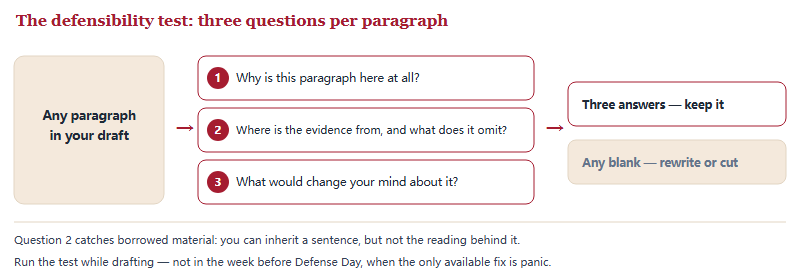
Question 2 is the trap door. A student can memorise a sentence someone else wrote and deliver it fluently. What they cannot do is describe the source it came from, explain why that source was chosen over an obvious alternative, or say what the evidence leaves out — because those things are the residue of reading, and reading cannot be handed over. This is also why the counterargument section of an essay is such a reliable tell: genuine concessions come from having met the opposing literature, and they are extremely hard to fake.
The feedback ladder: five kinds of help
“Did someone help you?” is the wrong question, because help is not one thing. These five rungs describe what a reader can actually do, ordered from the kind that makes you better to the kind that makes the essay somebody else’s.
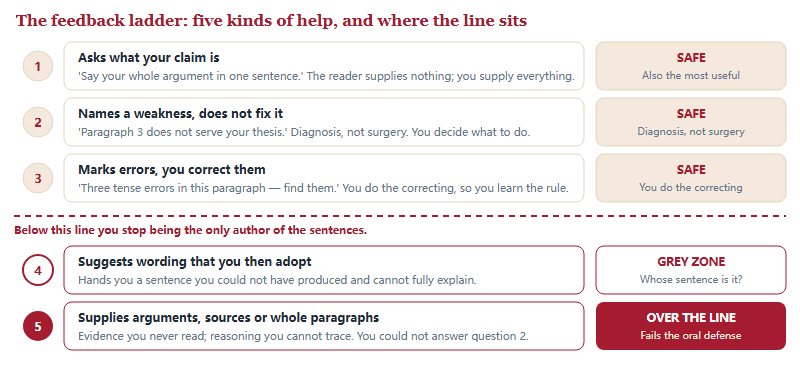
Rung 4 is where honest people get into trouble, so it deserves more than a label. A tutor rewrites your clumsy sentence into an elegant one; you read it, agree it is better, and keep it. Nothing feels like cheating. But two things have happened. First, the Style band of the rubric — 30 of the 60 marks, covering tone, spelling and grammar, adherence to the style guide, citations and overall ease of reading (see our rubric breakdown) — is supposed to measure your writing, and it no longer does. Second, you now have a sentence in your essay whose reasoning you did not perform, sitting in a document you will be asked to defend out loud.
The workable version of rung 4 is to have the problem pointed out and the improvement described in the abstract — “this sentence buries the subject under three clauses” — and then to fix it yourself. That is slower and it is how you get better. A student who has had two hundred sentences fixed for them has a good essay once; a student who has had twenty sentence problems explained can write the next essay alone.
How to brief a reader so you get the useful kind
Left to their own devices, many teachers and tutors default to rungs 4 and 5, not out of bad faith but because fixing is faster than teaching and they are trying to help. You have to tell them what you want. Hand any reader this brief:
- “Read for the argument, not the sentences. What do you think my claim is?” If they cannot say it back to you accurately, your introduction has failed — and introduction is one of the six Content dimensions. This is the single most valuable thirty seconds of feedback available.
- “Which paragraph is weakest, and why? Please do not fix it.” Diagnosis is what you are short of. Repairs you can do.
- “What is the strongest objection I have not answered?” This is rung 1 help that pays directly into analysis marks, and it is exactly what a judge will probe.
- “Mark where you got lost. Do not rewrite the transition.” Where a reader stumbles is data about structure and transitions; where a reader silently repairs your prose for you, that data is destroyed.
- “Ask me three questions a judge might ask, and let me answer out loud.” Free Defense Day rehearsal, and it works even with a reader who knows nothing about your topic.
And one instruction to give at the start: please do not type in my document. Comments in the margin, a separate note, or a conversation — all fine. Edits inside the file blur the record of who wrote what, which is the thing you may later need to be sure about. Keep your dated drafts and your reading notes for the same reason; if a question about authorship ever arises, a trail of your own working is worth more than any assurance you can offer.
Note what this reframes. A reader who can only fix commas is being wasted. A reader who asks hard questions about your argument is worth ten proofreaders — which means a subject teacher, a debating coach, or a parent with no background in international affairs at all can all be excellent readers, provided they ask rather than write.
For parents: three things that help, three that backfire
Parents of students in Chinese international schools are often the ones who found the contest in the first place, and the instinct to help with the English is strong. Here is where that effort pays and where it costs.
| Genuinely helps | Quietly backfires |
|---|---|
| Protect the calendar. The contest runs in fixed cycles, and the page describes registration as rolling with limited capacity — so the deadline that bites is often the registration one, not the submission one | Editing the English. A grade-8 or grade-11 essay should read like one. Style marks measure the student’s writing, and a polished adult register is conspicuous next to a student’s spoken defense |
| Pay for access, not for words. Library access, a database subscription, a good print source — these raise the ceiling on evidence without touching authorship | Choosing the topic. A topic selected for how impressive it sounds, rather than for what the student can actually defend for 15 minutes, collapses at exactly the wrong moment |
| Be the audience for the rehearsal. You do not need the subject knowledge. Ask “why?” three times in a row and you will find every soft joint in the argument | Treating the medal as the objective. Awards are described in percentile bands — gold, silver and bronze at the top 3, 10 and 20 percent per hir.harvard.edu. The band is not a controllable variable; the draft is |
A closing word on expectations, since this is where families most often ask us for a promise we cannot make. No writing competition result guarantees any admissions outcome, and no coaching — ours included — can guarantee a medal. What a genuinely self-authored entry does reliably produce is a student who can hold a position under questioning from adults who know the subject better than they do. That transfers to interviews, to supervisions, to university seminars, and it is worth more over five years than any certificate. It also happens to be the only asset in this process that cannot be bought, borrowed, or generated.
If you are between cycles now that the summer round has closed, this is the cheapest possible time to fix your feedback habits, because nothing is at stake in the next draft. At the time of writing, the contest page lists a Fall–Winter round with an article deadline of January 2, 2027 and Defense Day on February 5, 2027 — confirm current dates, division rules and the Submission Guide on hir.harvard.edu. For the contest in outline, see our overview of the HIR Academic Writing Contest; for the session that ultimately settles the authorship question, see our Defense Day preparation guide.
Frequently asked questions
Can my teacher read my draft?
The public contest page does not set out a human-feedback rule. Read the Submission Guide, confirm on hir.harvard.edu, and keep help to questions.
Is a grammar checker an AI tool?
hir.harvard.edu prohibits AI tools and software and screens with multiple checkers. Treat generative rewriting as out and confirm anything borderline.
What if a tutor already rewrote parts of my essay?
Rewrite those passages yourself before you submit. At the oral defense you have to be able to explain and defend every sentence.
Does the authorship declaration cover human help?
A declaration is required and sits outside the word count. For its exact wording and scope, check the official Submission Guide.
This is an independent guide operated by Hanlin Education for China-based international-school students. We are not affiliated with, endorsed by, or sponsored by the Harvard International Review or Harvard University. The HIR Academic Writing Contest is run by the Harvard International Review, a student-run journal founded in 1979. The feedback ladder above is our editorial guidance, not an official contest rule; rules, dates and the Submission Guide change between cycles — confirm current details on hir.harvard.edu before you enter, and contact the organisers directly on any question of eligibility or permitted assistance. Factual corrections are made within 7 working days.