Originality in an HIR essay is not about finding a topic no one has written about. It is about making a common topic answer a precise question. The Four-Lens Test below—Actor, Mechanism, Time Horizon, Geography—is a coaching diagnostic for turning a broad theme into a defensible HIR argument. It is not an official HIR rule or scoring criterion. No current HIR note defines an official originality test or scoring rule for topic distinctiveness in the source material reviewed for this article. Use this method to pressure-test whether your angle can sustain analysis, evidence, and a clear thesis.
Why Common Topics Produce Generic HIR Essays
Students often choose topics such as artificial intelligence, climate change, inequality, or globalisation because these subjects are important, widely discussed, and easy to research. The problem is not the subject. The problem is that a broad subject invites a predictable thesis. A generic HIR essay about AI and employment often says: “AI will displace workers, so governments should retrain them.” The evidence becomes a list of news reports, the analysis repeats familiar claims, and the conclusion recommends a well-known policy. The essay may be accurate, but it does not show the writer making a distinct analytical choice.
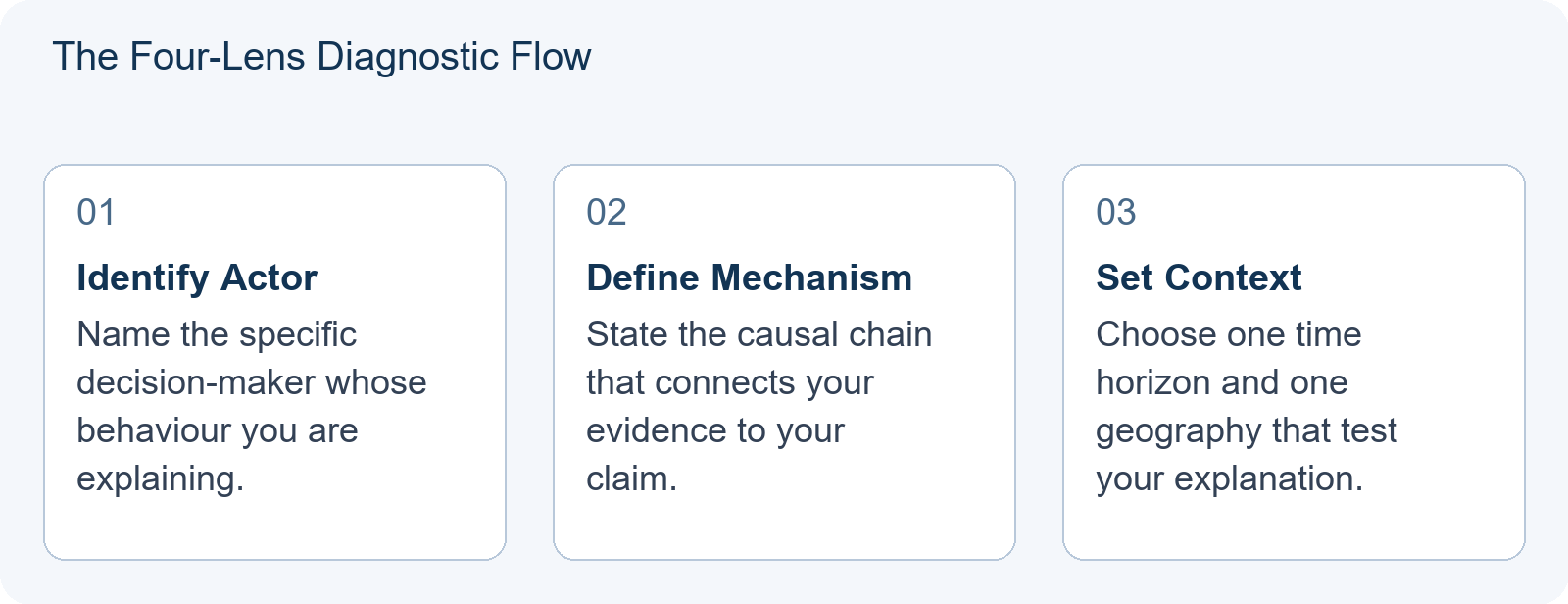
A stronger HIR essay narrows the question until the writer can explain a specific outcome. The Four-Lens Test forces that narrowing. It asks you to identify the actor whose behaviour you are explaining, the mechanism that connects cause to effect, the time horizon that fits your evidence, and the geography that tests your explanation. Each lens reduces the space for vague language. Together, they help you move from “AI is changing work” to a question that can be argued, evidenced, and defended.
The Four-Lens Test at a Glance
| Lens | Core question | What it forces you to decide | Warning sign |
|---|---|---|---|
| Actor | Whose behaviour or decision are you explaining? | The specific person, institution, or group with agency. | You rely on “governments,” “companies,” or “society.” |
| Mechanism | What causal process connects your evidence to your claim? | The steps between cause and effect. | You list correlations without explaining how they operate. |
| Time Horizon | Are you analysing a moment, a trend, or a structural shift? | The period and type of change your evidence covers. | You mix short-term reactions with long-term predictions. |
| Geography | Which country, region, or comparison tests your explanation? | The context that makes your claim specific and testable. | You write about “the world” or “developing countries” as a backdrop. |
Lens 1: Actor — Whose Behaviour Are You Explaining?
The first lens requires you to name the agent whose actions drive the outcome. A generic essay treats large categories as if they made decisions. A distinct HIR argument specifies who acts, what incentives they face, and what constraints limit them. For example, “countries are struggling with inflation” is not an argument. “A central bank’s communication strategy changed household inflation expectations” is closer to one because it identifies an actor and a behaviour.
Ask three diagnostic questions:
- Who must change their behaviour for my thesis to be true?
- What decision are they actually making?
- What evidence would show that this actor, rather than another, is central?
If your answer is “the government,” keep asking which part of government. A finance ministry, a customs authority, a competition regulator, and a local education board all face different incentives. If your answer is “companies,” specify whether you mean multinational headquarters, domestic suppliers, platform firms, or small exporters. The actor lens does not make your essay narrow for its own sake. It makes your causal claim visible.
Lens 2: Mechanism — What Causal Process Connects Evidence to Claim?
A mechanism is the logical chain that explains how X leads to Y. Many students present a correlation and call it an argument. They show that two things happened at the same time, or that one country adopted a policy and later experienced a result. But a reader needs to know the process. Did the policy change prices? Did it alter incentives for firms? Did it shift information available to voters? Did it create a new enforcement problem?
Consider the difference between these two claims:
- “Social media polarises politics.”
- “Recommendation algorithms increase engagement by promoting emotionally charged content, which raises the visibility of extreme positions among users who already seek confirmation.”
The second claim is not automatically true, but it is testable. It identifies a mechanism: algorithmic ranking, emotional content, engagement incentives, and user psychology. It tells you what evidence to look for and what evidence would weaken the claim. If your mechanism is unclear, your essay will drift into description. A clear mechanism keeps the essay focused on explaining, not just summarising.
Lens 3: Time Horizon — Moment, Trend, or Structural Shift?
Time horizon determines what kind of evidence is appropriate. A moment is a single event or short episode, such as a policy announcement, a natural disaster, or a court ruling. A trend is a gradual change over several years, such as rising remote work or declining birth rates. A structural shift is a deeper transformation in how a system operates, such as the move from manufacturing to service employment or from cash to digital payments.
These levels are not interchangeable. If you analyse climate migration as a moment, you might focus on one displacement event. If you analyse it as a structural shift, you need long-term evidence about agricultural yields, urban capacity, and labour markets. Mixing the two without distinction creates logical gaps. A reader may ask why a short-term reaction proves a long-term transformation.
Choose one horizon and state it. A useful sentence in your introduction is: “This essay examines a five-year trend, not a single event or a permanent structural break.” That sentence tells the reader how to judge your evidence. It also protects you from overclaiming.
Lens 4: Geography — Which Context Tests Your Explanation?
Geography is not just a setting. It is a variable that tests whether your explanation holds. A generic essay uses “the world” or “developing nations” as a vague backdrop. A distinct HIR essay specifies a country, region, city, or comparison pair that makes the mechanism visible. Why did a policy produce one result in one context and a different result elsewhere? What local institutions, economic conditions, or cultural factors change the outcome?
Comparative geography is especially powerful. If you argue that a digital tax reduces market concentration, compare two jurisdictions with different enforcement capacity. If you argue that remote work changes urban housing demand, compare two cities with different commuting patterns and housing supply. The comparison does not need to be between countries. It can be between regions, cities, or even types of firms. The point is to show that your explanation is sensitive to context, not universal by assumption.
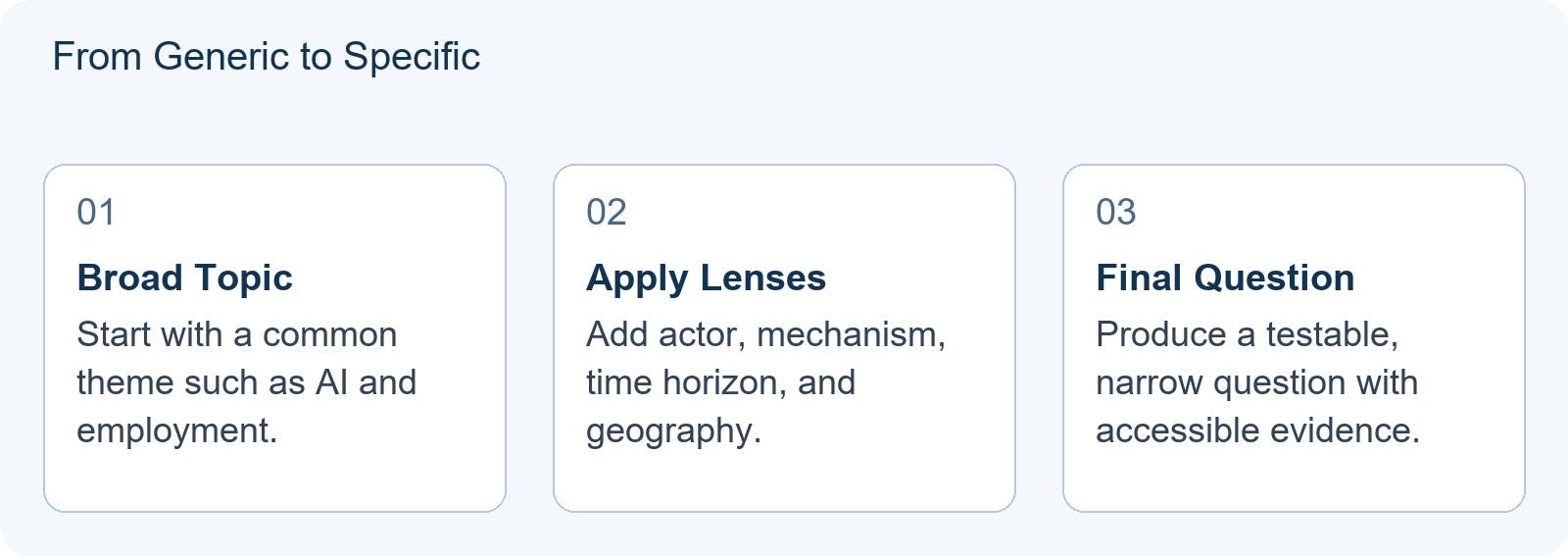
Worked Teaching Illustration: From Generic to Specific
The following is a hypothetical teaching illustration. It is not a past or current HIR prompt, and it does not report real research findings. It shows how the four lenses can transform a common topic into a more answerable question.
Common topic: AI and employment.
Generic thesis: “AI will take many jobs, causing unemployment, so governments should retrain workers.”
Apply the four lenses:
- Actor: Mid-level administrative staff in law firms within one national legal services market.
- Mechanism: Automation of document review reduces billable hours for routine tasks, changing how firms allocate work between junior staff and senior partners.
- Time Horizon: A five-year adoption trend, not a single technology launch or a permanent structural prediction.
- Geography: Two cities with different client bases—one focused on corporate litigation, the other on local property and family law.
Resulting question: “How did the adoption of AI document review tools over a five-year period alter the allocation of routine legal work between junior staff and senior partners in two cities with different client bases?”
This question is not necessarily the best HIR question, but it is specific, testable, and evidence-friendly. It identifies an actor, a mechanism, a time horizon, and a geographic comparison. It also avoids an unverifiable prediction about the future. A writer could find hiring data, billing records, firm surveys, or trade-press reporting to support or challenge the thesis.
Diagnostic Table: Generic vs. Four-Lens Angle
The table below is an illustrative comparison only. It does not describe a specific HIR prompt or official scoring guidance.
| Component | Generic angle | Four-lens angle (illustrative) |
|---|---|---|
| Topic | Climate change | A carbon border tariff |
| Actor | Governments | A customs authority in an importing country |
| Mechanism | Pollution is bad | The tariff changes import costs based on embedded emissions, altering sourcing decisions |
| Time horizon | The future | The first three years of implementation |
| Geography | Global | An importing country compared with an export-dependent middle-income economy |
How to Avoid Fake Originality
Specificity is not the same as contrarianism. Taking a shocking position without evidence does not make an essay original. Inventing an obscure connection does not either. True originality comes from clarity, precision, and depth. If your angle is specific but unsupported, it will fail. If it is controversial but poorly reasoned, it will fail. If it predicts a future event with no available evidence, it will fail.
Use three tests before you commit to an angle:
- Evidence test: Can I find credible sources that speak directly to this actor, mechanism, time horizon, and geography?
- Counterargument test: What is the strongest objection to my causal claim, and how would I answer it with evidence rather than assertion?
- Scope test: Does my question require evidence I can actually access within the essay’s word limit?
If you cannot pass these tests, simplify. A narrower question with strong evidence is better than a dramatic question with weak support.
A Pre-Draft Checklist
Before you write your HIR essay, complete these four sentences:
- My actor is ______, and the decision or behaviour I am explaining is ______.
- My mechanism is ______, which connects ______ to ______.
- My time horizon is ______; I am not claiming ______.
- My geography is ______, and it tests my explanation by ______.
If any sentence is vague, your opening paragraphs will be vague too. If all four sentences are specific, you have a defensible analytical core. You can then build your evidence, counterargument, and conclusion around that core.
Conclusion: Use the Lenses Before You Draft
HIR essay originality is not about avoiding common topics. It is about making a common topic answer a precise question. The Four-Lens Test—Actor, Mechanism, Time Horizon, Geography—gives you four ways to test whether your angle is distinct, arguable, and evidence-friendly. Apply the test before you draft, not after. If your question survives the lenses, you have a stronger foundation for the rest of the essay.
To connect this test to broader scoping, see HIR Essay Scope: Turning a Global Topic Into an Answerable Question. If your draft risks becoming a tour of facts, use When Your HIR Essay Is a Fact Tour: A Three-Layer Test for Answering the Prompt. And after you sharpen the angle, prepare objections with Steelman the Objection: How to Write the Counterargument Paragraph in an HIR Essay.
General event background is available at Event background.
This is an independent preparation guide, not affiliated with, endorsed by, or sponsored by the Harvard International Review.
Frequently Asked Questions
Is this Four-Lens Test an official HIR rule?
No. It is coaching guidance, not an official HIR rule. It reflects a practical method for scoping an argument, but it is not part of official scoring guidance.
Can I use this method for any HIR theme?
Yes, the lenses can be applied to any HIR theme. However, the actor, mechanism, time horizon, and geography will vary depending on your prompt and division. The method is a diagnostic, not a template for content.
Does a more specific topic guarantee a higher score?
No. Specificity helps create a defensible argument, but the quality of your evidence, reasoning, structure, and writing still matters. A specific topic with weak evidence will not succeed. Use the four lenses to improve your question, then do the research.