Short answer. For the 2026-27 HIR Fall/Winter cycle, audit each hyperlinked citation twice: once when you freeze the draft before the 2 January 2027 submission deadline, and again before the 5 February 2027 Defense Day if you are named a finalist. This HIR citation link audit asks one question per citation: does this link still open the page that still contains the exact fact, figure or quotation my sentence relies on? A link that now resolves to a homepage, a redirect or a revised table has stopped doing citation work, even when the publisher is beyond reproach. Below is a repeatable audit row, a hypothetical repair worked three ways, and the one-line note that turns a live link into something you can actually say out loud.
Site note: HIR is the Harvard International Review’s academic writing contest for secondary students. This site is an independent guide and is not affiliated with or endorsed by the Harvard International Review or Harvard University.
What HIR asks for, and what this audit adds
The Fall/Winter cycle is the live one: essays are due 2 January 2027, and successful finalists attend the online HIR Defense Day on 5 February 2027. Both the Junior and Senior divisions write 800-1,200 word English essays. In a 29 September 2026 cycle report by Hanlin Courses, “2026 HIR Harvard International Review Writing Summer Cycle Results Released; the Fall/Winter Cycle Follows,” the source records that HIR entries use AP Style, that key facts, data, policies and quotations need reliable sources, and that charts and data need their own source attribution. Our verified cycle notes add the presentation rules that matter here: no footnotes, citations delivered as hyperlinks, and an 800-1,200 word limit excluding figures. The rubric totals 60 points across twelve scored rows, split evenly between content and style, so how a citation is presented is not a cosmetic afterthought.
None of that is a link-integrity rule. The verified expectations concern source quality and attribution style; nothing in them says a cited page must remain unchanged until Defense Day. The audit below is our editorial method — a way of testing whether your citations still work — not an official requirement, and it never overrides the question of whether a source was worth citing in the first place.
| Verified expectation | Audit question it generates | Where the boundary sits |
|---|---|---|
| Key facts, data, policies and quotations need reliable sources | Is the publisher the right kind of source for this specific claim? | Source screening, not link durability — see Which Sources Actually Count: Building a Clickable Evidence List for an HIR Essay From China |
| Citations are hyperlinked, with no footnotes | Does the link open the document, not a landing page or search result? | This article |
| Charts and data need source attribution | Does the link open the table or figure, with its indicator definition and period visible? | This article |
| 800-1,200 words excluding figures | Does naming the source cost more words than the claim is worth? | Word budgeting, not link integrity |
Why a credible source can still fail a link check
A publisher can revise a page without warning. A statistics ministry may re-base an index; a multilateral database may revise a series after a methodology review; an agency may migrate its site and leave redirects pointing at broad category pages. The URL survives; the number does not. That is why a link audit is separate from source screening: a publisher may be credible and still revise a page, so an autumn URL may resolve to changed content by January.
Six failure modes are worth checking:
- Homepage drift. The link opens an organisation’s front page, and the table sits several clicks away. A reader cannot verify the sentence.
- Redirect without content. The old address forwards somewhere valid, but the specific table or indicator has been retired.
- Silent revision. The page loads, but the figure has been revised and no longer matches your sentence.
- Version churn. A PDF has been replaced by a later edition under a near-identical filename, so the link now points at a different document than the one you read.
- Search-result links. The address is a query string rather than a document: it returns different results later and does not identify the publisher.
- Access walls. The page exists, but a reader outside your network or login cannot reach the passage you quoted.
The distinction matters because the two failures need different repairs. A source that was never adequate needs replacing; a credible source with a broken link needs re-pointing, versioning or a dated fallback. For the second problem in more depth, see Your Evidence Will Age Before Defense Day: Writing HIR Claims That Survive the News Cycle.
The audit row: eight fields per citation
One row per claim, not one row per link. If a single link supports three separate sentences, it gets three rows, because each sentence can fail independently. Keep the table in a working file; it is not part of the submission.
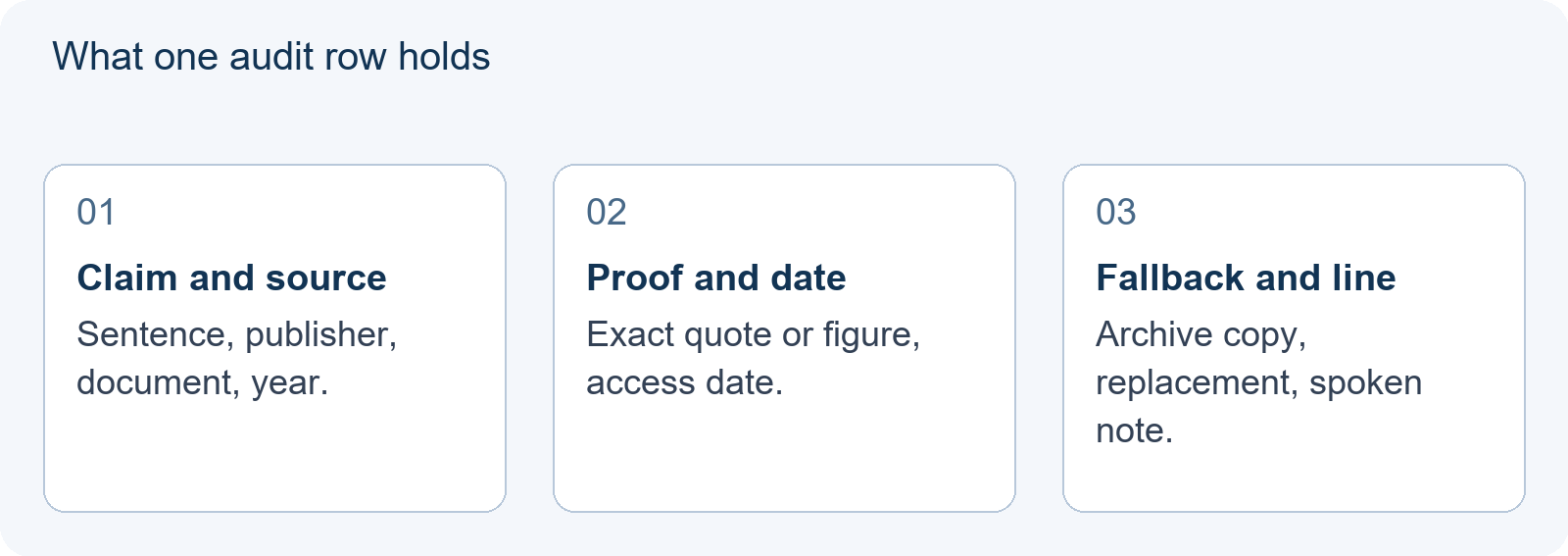
| Field | What to write | Failure it catches |
|---|---|---|
| 1. Claim sentence | The sentence verbatim, as it appears in the draft | Vague memories of “what the source was for” |
| 2. Source identity | Publisher plus document title plus year | Bare homepages that identify nothing |
| 3. Live URL | The exact address you will hyperlink | Query strings, shortened links, landing pages |
| 4. Exact support | The quoted sentence, figure, or table and row number | Links that open a page the claim is not on |
| 5. Access date | The date you last confirmed field 4 | Undated reliance on a page with a “last updated” stamp |
| 6. Archive fallback | A dated snapshot or saved PDF with its capture date | Total loss when the page is retired |
| 7. Replacement source | One equivalent document with the same indicator definition | Panic substitutions made at the deadline |
| 8. Defense Day note | One spoken line: what this source shows, and the fallback | Links you cannot explain without clicking |
Field 4 is easy to skip, and it decides everything else. “The ministry’s statistics page” is not support; “table 4.2, renewable share of electricity generation, 2023” is.
Worked teaching illustration: one broken link, three defensible repairs
Teaching illustration — a hypothetical draft used to show the method. It is not an actual contest entry, a past prompt, or scoring guidance.
A Senior Division draft contains the sentence: “Between 2019 and 2023 the share of electricity generated from renewables in Country X rose from 17 percent to 31 percent.” The writer hyperlinked the ministry’s statistics landing page. At the freeze audit, that page now leads to a download centre; the 2023 table sits on a sub-page, and the revised series shows 29 percent for 2023. The 2019 figure is unchanged.
| Repair | What changes in the essay | Best when | Risk to watch |
|---|---|---|---|
| A. Follow the document | Relink to the specific table page and change 31 to 29, noting that the series was revised | You want the reader to land on the current official page | Another sentence or figure elsewhere in the draft may assume the older value |
| B. Pin the version | Keep 31 percent only if you can name the edition, link an archived snapshot of the earlier table, and state the capture date in the audit row | Your argument depends on the figure as published at the time | A reader may see a superseded number, so your one-line explanation has to be ready |
| C. Substitute the indicator | Replace with a multilateral table that reports both years on one page under a stated definition | The ministry page is unusable and the concept is defined consistently | Definitions can differ — gross versus net generation, share of electricity versus share of final energy — which silently changes the claim |
The audit does not choose for you. It forces the choice to be explicit, dated and defensible. Two rules keep the repairs honest. First, never fix the link while leaving the sentence alone, or the reverse: if the number moved, the sentence moves with it. Second, if a substitute source defines the indicator differently, it is not a replacement — it is a new claim that needs its own evidence.
Write the source into the sentence, not just into the link
A hyperlink disappears when the essay is printed, converted, or read aloud on Defense Day. If the sentence names nothing, the citation effectively vanishes with the underline. A compact pattern survives all three conditions: publisher, document and year inside the sentence, with the link placed on the document name.
Compare “renewable generation rose sharply” (link) with “the Ministry of Energy’s Energy Statistics 2023 puts the renewable share at 29 percent (table 4.2).” The second version lets a reader who cannot click still identify the source, and it tells an examiner exactly which number you are defending. AP Style guidance also applies inside that phrase — “29 percent” spelled out, not “29%” — so run the style pass in the same sitting rather than as a separate tidy-up.
The cost is real. Naming a source adds words inside the same 800-1,200 band, so spend them where a reader must be able to check: contested figures, contested policies, direct quotations. Do not stack three unrelated claims onto one link and hope the reader finds all three.
Turning links into Defense Day language
Only finalists attend Defense Day, so this section applies to a subset of entrants — but the note is worth writing at draft stage, because it exposes citations that were never really understood. On the day you cannot click, so each audited row needs a spoken version with three parts: what the source is, what it shows, and what you would point to if the live page had changed.
A usable spoken line is short: “That figure comes from the Ministry of Energy’s 2023 statistics table, which I checked during my final audit; the archived copy I saved shows the same value if the live table has since been revised.” That sentence proves three things at once — you know the publisher, you know the number, and you have a fallback. A link you cannot describe in one line is a link you cannot defend. The fuller backup-sheet structure is set out in HIR Defense Day Q&A: Build an Evidence Backup Sheet From Your Own Claims.
Audit schedule and five errors to catch
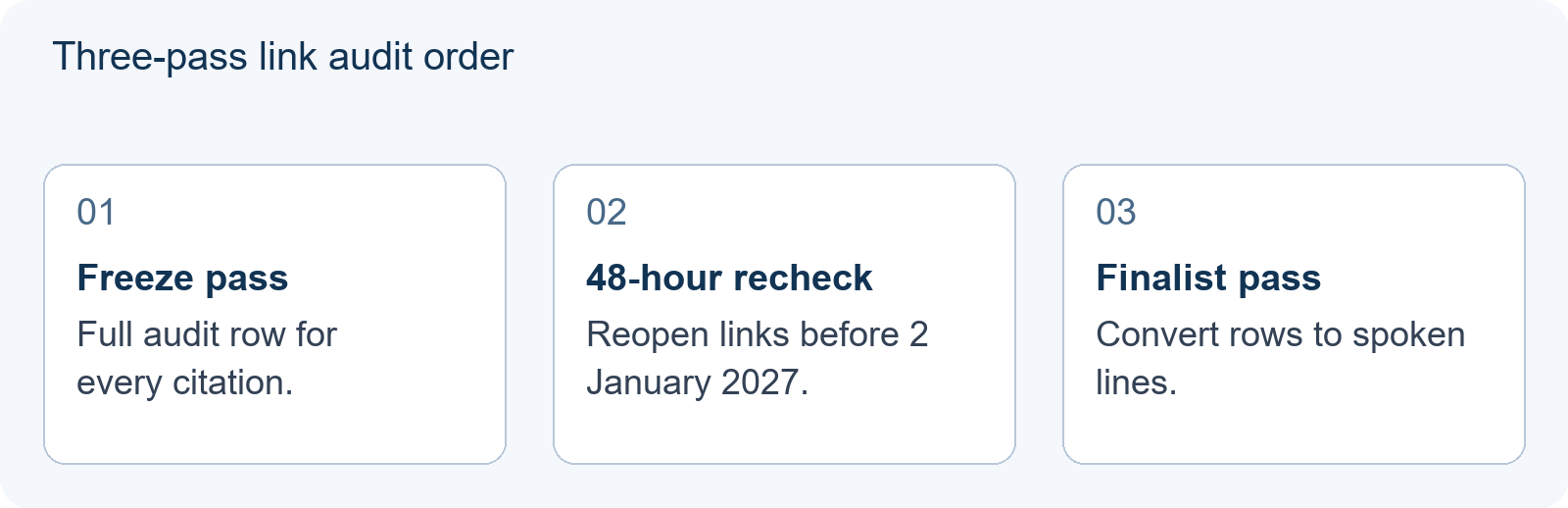
Three passes are enough. The freeze pass runs when the draft stops changing structurally: every citation gets a full row, and every broken link gets a repair. The 48-hour recheck shortly before 2 January 2027 touches only fields 3 and 4 — open each link, confirm the figure, update the access date. The finalist pass, if it applies, runs in the days before 5 February 2027 and converts each row into a spoken line.
Five errors to catch:
- Linking a homepage for a specific statistic, which hands the verification work back to the reader.
- Linking a search results page instead of the document the search found.
- Citing an aggregator for a figure whose primary table is publicly available.
- Overloading one link with several claims, so a single revision breaks three sentences at once.
- Repairing the link but not the sentence, leaving a draft that cites a 29 percent table while asserting 31 percent.
None of these are style points an examiner is hunting for. They are integrity failures that surface the moment someone tries to check your work — which is precisely what the audit simulates.
Preparing for a citation and evidence review
A second reader can work faster with four things: the draft with live links, the eight-field audit table, the three citations you are least confident about, and the repair you have already chosen for each with your reason. That turns a general “please check my sources” request into a specific one. If your repairs have pushed the draft over the limit, deal with the word count before the review rather than during it.
General event background is available at Event background.
Frequently Asked Questions
Do I have to archive every source I cite in an HIR essay?
No verified rule requires it. Archiving is our suggested working practice, applied selectively: save a dated copy of the pages whose figures or quotations could plausibly change before January, and keep the live publisher link as the citation itself. An archive copy is a fallback and a Defense Day aid, not a substitute for identifying the publisher in your sentence.
What if the page has been reorganised but the figure is unchanged?
Then the citation still works, but re-point the link at the specific table rather than the landing page, and update the access date in your audit row. Check the surrounding definition too — a restructured page sometimes carries the same headline number with a different indicator, a different period, or a revised table numbering, any of which can make a correct-looking link support a slightly different claim.
Can I hyperlink a search results page or a news report instead of the original document?
We would not, for two different reasons. A search-result address is a query rather than a document: it returns different results later and does not identify a publisher, so it cannot substitute for a citation. A news report can be cited for what that outlet reported, but if your sentence quotes a statistical figure, link the table the figure came from where it is publicly available, and keep the report as context rather than as the evidentiary base.