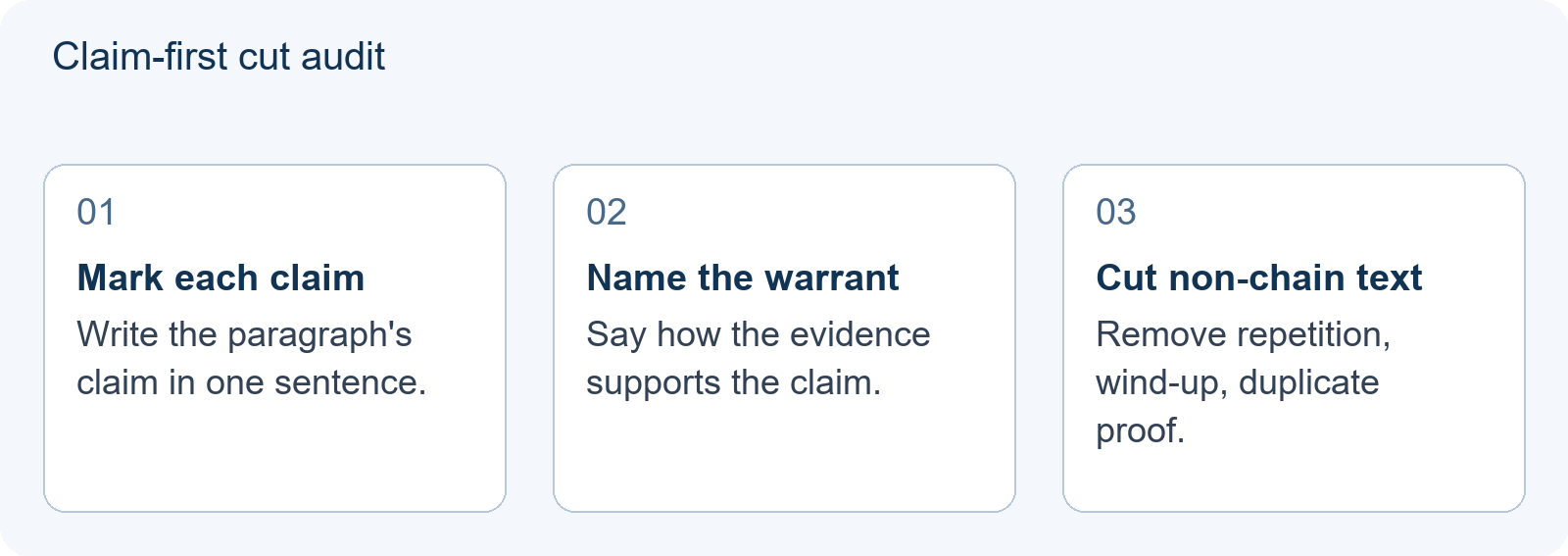
If your HIR essay word count is over the 800–1,200 limit, the first move is not to delete sentences. Mark each paragraph’s claim, warrant, and evidence, then cut only prose that does not change that chain. The limit excludes figures, not the argument around them. This audit is written for the live Fall-Winter cycle: the essay deadline is 2 January 2027, and Defense Day is 5 February 2027. This independent revision guide is not official HIR scoring guidance.
Quick answer: audit the argument before the sentence count
A word-count problem can look like a sentence problem when it is really a structure problem. A draft repeats its thesis in three paragraphs, introduces each example twice, and spends fifty words clearing its throat before every claim. Cutting adjectives from that draft feels painful because the writer is treating symptoms. The better sequence is: label what each paragraph proves, identify the sentence that links evidence to that claim, and then remove text that does neither. This is a coaching judgment, not an official scoring formula. The verified HIR rubric is 60 points: 12 rows scored from 1 to 5, divided into 30 Content points and 30 Style points. The verified rubric summary does not establish any conversion from a specific word count to a specific score.
That distinction matters. The 800–1,200 range is a rule to meet, not a row to win. A draft at 1,198 words is not automatically stronger than a draft at 1,040 words. The question is whether the shorter draft still contains the claim, the warrant, and the evidence a reader needs. If a cut removes the only sentence explaining why a statistic supports the thesis, the draft may become more compliant and less persuasive at the same time.
What the limit does and does not decide
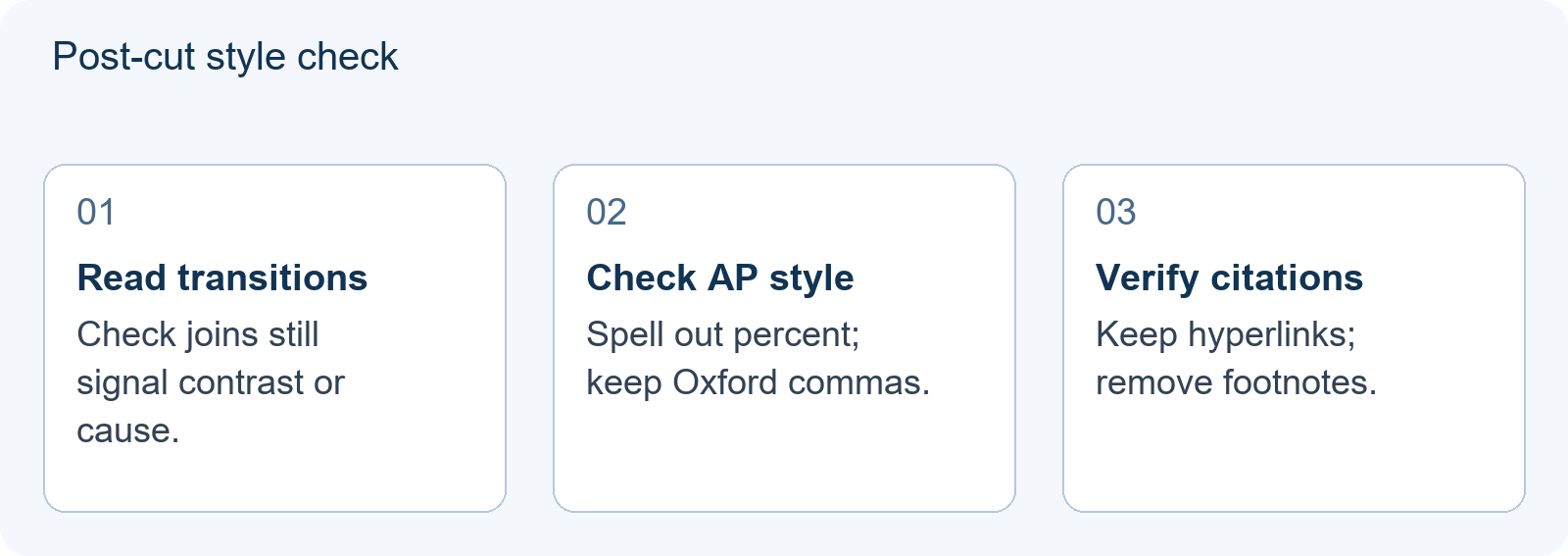
The verified style rules are specific: write percent as a word, use the Oxford comma, do not use footnotes, use hyperlinked citations, and stay within 800–1,200 words excluding figures. Those are rule-compliance checks. They do not say that a particular paragraph must have a particular length, or that a certain number of words earns a certain number of Content or Style points. Do not invent a conversion the rubric does not provide.
For revision, treat the limit as a design constraint. Figures are excluded, but the prose that explains a figure is still prose. A chart does not carry its own warrant. If the body says only “Figure 1 shows the trend,” the writer has saved words but not done the analytical work. The fix may be to cut a different passage and spend twelve words linking the figure to the claim. That is a better trade than deleting the only explanation of mechanism.
Set a working target, not a fantasy target. If the draft is at 1,260 words, a 60-word cut may be enough. If it is at 1,500, do not spend an hour shaving adjectives; find repeated claims and duplicated evidence. The “right” number is the shortest version that keeps the argument auditable.
Build a cut ledger before touching prose
A cut ledger is a simple table you fill in before revision. For each proposed cut, record the words removed, the claim preserved, and the rubric function at risk. The last column is the safeguard: it forces you to name what the sentence was doing before you delete it. The table below is a suggested teaching ledger for a 140-word cut, not an official scoring device. Its targets add to 140, but they are planning estimates, not quotas.
| Cut type | Diagnostic question | Suggested target in a 140-word cut | Rubric function at risk |
|---|---|---|---|
| Repeated thesis | Does this sentence restate a claim already made? | 40 words | The one thesis sentence that carries the argument |
| Throat-clearing | Does the paragraph begin with wind-up rather than a claim? | 35 words | A transition that signals contrast or cause |
| Duplicate evidence | Do two examples prove the same warrant? | 40 words | The stronger example and its link to the claim |
| Uncompressed warrant | Can a because-clause become a precise claim? | 25 words | The causal link or condition that makes evidence relevant |
| Total | Plan before cutting | 140 words | Do not cut the argument’s load-bearing sentences |
Use the ledger on whole paragraphs, not isolated sentences. A sentence that looks redundant may be the only bridge between two sections. A sentence that looks essential may be a second version of the same point. The ledger makes that judgment visible instead of leaving it to fatigue.
Teaching illustration: a hypothetical 97-word passage
This is a teaching illustration, not an actual contest submission and not official scoring guidance. The passage below is 97 words under an ordinary space-separated count; hyphenated terms are counted as one word. A standard word processor may count slightly differently, so use your own workflow’s count for a real draft.
“Across many cities, remote work has changed commuting patterns in ways that policymakers did not expect. This matters because transport budgets are often fixed years in advance, so a decline in peak-hour demand can leave rail systems with less fare revenue while their operating costs remain high. The result is a planning problem: agencies must decide whether to cut service, raise subsidies, or redesign routes for a more dispersed workforce. These choices affect not only commuters but also the credibility of long-term climate targets, because public transport is often treated as a central tool for reducing emissions.”
A cut plan removes 31 words and leaves 66. The first cut deletes “in ways that policymakers did not expect” (7 words). The claim “remote work has changed commuting patterns” survives. The risk is that the surprise itself may matter; if the paragraph later depends on policymakers being unprepared, keep the phrase and cut elsewhere. The second cut deletes “The result is a planning problem:” (6 words). The next sentence already states the decision, so the signpost is disposable. The third cut compresses a 27-word sentence to 9 words: “The credibility of long-term climate targets is at stake.” That removes 18 words, but it also removes the explicit because-clause. Use this compression only if the next paragraph supplies the mechanism; otherwise the writer has cut a warrant.
| Cut | Words removed | Claim preserved | Rubric function at risk |
|---|---|---|---|
| Delete “in ways that policymakers did not expect” | 7 | Remote work changed commuting patterns. | Loses surprise emphasis; keep if surprise is the claim. |
| Delete “The result is a planning problem:” | 6 | Agencies must choose among service, subsidy, and routes. | Loses signpost, not logic. |
| Compress the climate-target sentence | 18 | Climate-target credibility remains at stake. | Loses explicit warrant; restore a because-clause if needed. |
| Total | 31 | 97 words to 66 words | Recheck the argument after every structural cut. |
The revised passage reads: “Across many cities, remote work has changed commuting patterns. This matters because transport budgets are often fixed years in advance, so a decline in peak-hour demand can leave rail systems with less fare revenue while their operating costs remain high. Agencies must decide whether to cut service, raise subsidies, or redesign routes for a more dispersed workforce. The credibility of long-term climate targets is at stake.” It is shorter, but it is not automatically better. The writer must now supply the missing link in the next paragraph or reverse the third cut.
Protect the claim, warrant, and evidence after cuts
After cutting, run a paragraph-level audit. For each paragraph, write one sentence: “This paragraph proves that ___ because ___.” If you cannot fill both blanks, the paragraph may be a fact tour rather than an argument. The first blank is the claim; the second is the warrant that connects evidence to the claim. A paragraph with evidence but no warrant often needs a sentence added, not more words removed. A paragraph with a warrant but no evidence may need a source, not a smoother transition.
Flag orphan evidence. This happens when a statistic or quotation survives a cut but the sentence explaining its relevance disappears. The reader sees a number and does not know what it is supposed to prove. Also flag repeated thesis statements. A conclusion that restates the introduction in nearly the same words may be safe to shorten; a conclusion that names the implication of the argument may be doing real work. The cut ledger should record which one you are deleting.
Do not “fix” length by removing all counterargument. A shorter objection can still be a real objection. If a paragraph acknowledges a competing explanation, compress the setup and keep the reason your claim survives it. If you delete the objection entirely, you may save 40 words and lose the analytical contrast that made the argument persuasive.
Style after cuts: the checks that often break
Cutting prose can break style compliance. Recheck transitions first: a sentence that began with “However” may now sit beside a sentence that already signals contrast. The article Ten of the 60 Points Are in the Joins: Transitions and Coherence in an HIR Essay is useful for testing whether the joins still carry the argument. Then recheck AP style. The verified rules require percent spelled out, the Oxford comma, no footnotes, and hyperlinked citations. The article AP Style for International Affairs: The Rules That Actually Cost HIR Points gives a practical style pass; use it after the structural cuts, not before.
Do not convert “percent” to “%” to save words. Do not move citations into footnotes to save space; footnotes are prohibited by the verified style rules. Do not strip hyperlinks to make the page look cleaner. If a cut removes the sentence that introduced a source, rebuild the attribution so the link still has a visible purpose. The article Which Sources Actually Count: Building a Clickable Evidence List for an HIR Essay From China is relevant when a shortened paragraph leaves a citation stranded.
Contest-rule details in this article are dated to the verified HIR information available on 2 November 2026. Recheck the official HIR materials before you submit, because a current style sheet or cycle instruction overrides any general revision advice.
Final diagnostic: symptom, cause, safe cut, do not cut
| Symptom | Likely over-length cause | Safe cut | What must not be cut |
|---|---|---|---|
| Every section restates the thesis | Repeated framing | Keep one full thesis in the introduction; shorten later echoes. | The sentence that states the essay’s actual answer. |
| Paragraphs begin with broad context | Throat-clearing | Start with the paragraph’s claim, then add only needed context. | A transition that signals contrast or causation. |
| Two examples make the same point | Duplicate evidence | Keep the stronger example and its warrant. | The link between example and claim. |
| Long because-clauses | Uncompressed warrant | Turn the clause into a precise claim and move detail later. | The condition that makes the evidence relevant. |
| Citations look orphaned | Attribution sentence deleted | Rebuild a short signal phrase and keep the hyperlink. | The source’s name, date, and relevance. |
This table is a diagnostic, not a guarantee. A draft can have all five symptoms and still need a structural rewrite rather than a sentence-level trim. If the argument changes every time you cut a paragraph, the problem is not word count alone.
How to request a draft audit without outsourcing the entry
A useful review request is narrow. Give the reviewer the current word count, the 800–1,200 target, a one-sentence claim for each paragraph, three passages you refuse to cut and why, the style checks you have already run, and the deadline you are working toward. Ask for a rubric-mapped diagnosis and a cut ledger, not a rewritten entry. From a Hanlin preparation perspective, that brief helps a teacher respond to your reasoning rather than replace your voice. Confirm the actual scope of any support directly; no checklist here is a promise of a particular service.
The strongest revision is usually the one the writer can explain. If you cut 140 words, be ready to say which claim each cut protected and which warrant you checked afterward. That is also useful preparation for Defense Day, where the argument may be discussed rather than read. A shorter essay is not a safer essay unless the remaining sentences still do the work the rubric asks them to do.
General event background is available at Event background.
This is an independent preparation guide, not affiliated with, endorsed by, or sponsored by the Harvard International Review.
Frequently Asked Questions
Does the HIR word limit include figures?
The verified style rule says 800–1,200 words excluding figures. Prose that explains a figure still counts, and the verified rubric summary does not establish any word-count-to-score conversion.
Should I cut evidence to get under 1,200 words?
Usually no. Cut repeated thesis statements, throat-clearing, duplicate examples, and uncompressed warrants first. If evidence loses its explanation, restore the link or replace the example; deleting the only support weakens the argument.
Can I use footnotes to save words?
No. The verified style rules require hyperlinked citations and no footnotes. After cutting, recheck transitions, percent spelled out as a word, the Oxford comma, and every citation link.